Tag: Award winning project

Precision at Scale: Inside the Award-Winning Porcelain Paver Installation at Hyatt Scottsdale

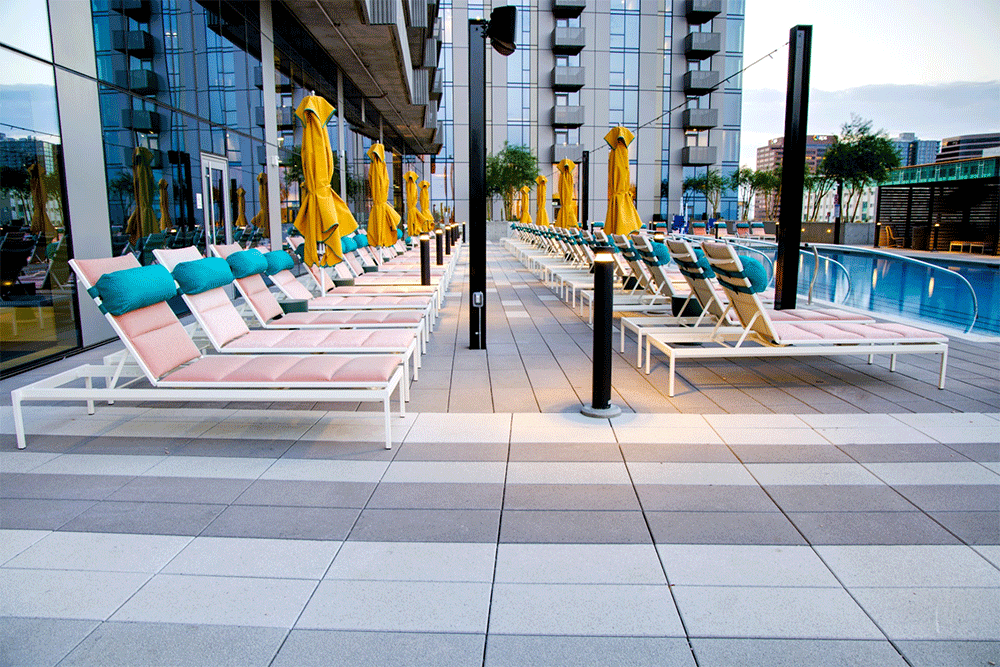
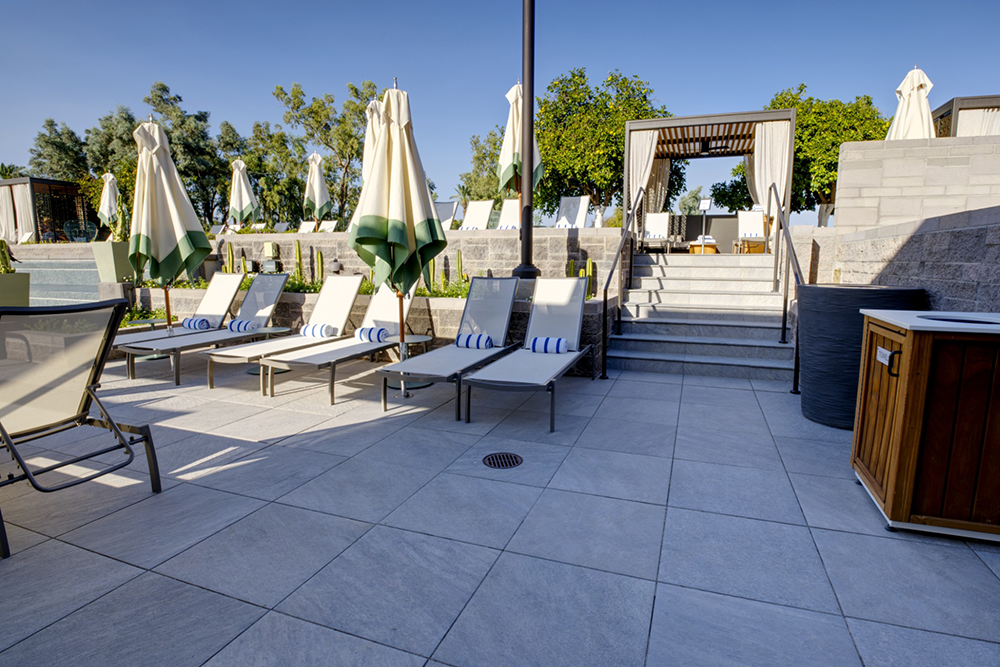
When the pool complex at Hyatt Regency Scottsdale Resort & Spa at Gainey Ranch reopened after renovation, it didn’t just look refreshed. It felt redefined. What had once been, “tired,” emerged as the crown jewel of the property.

This expansive, precisely executed porcelain paver installation from European Pavers Southwest Inc. would go on to win the Porcelain Paver Pavement – Commercial category at the 2025 Hardscape North America Awards, offering many lessons for aspiring and early-career hardscapers along the way.  

Reimagining 2.5 Acres of Pool Deck

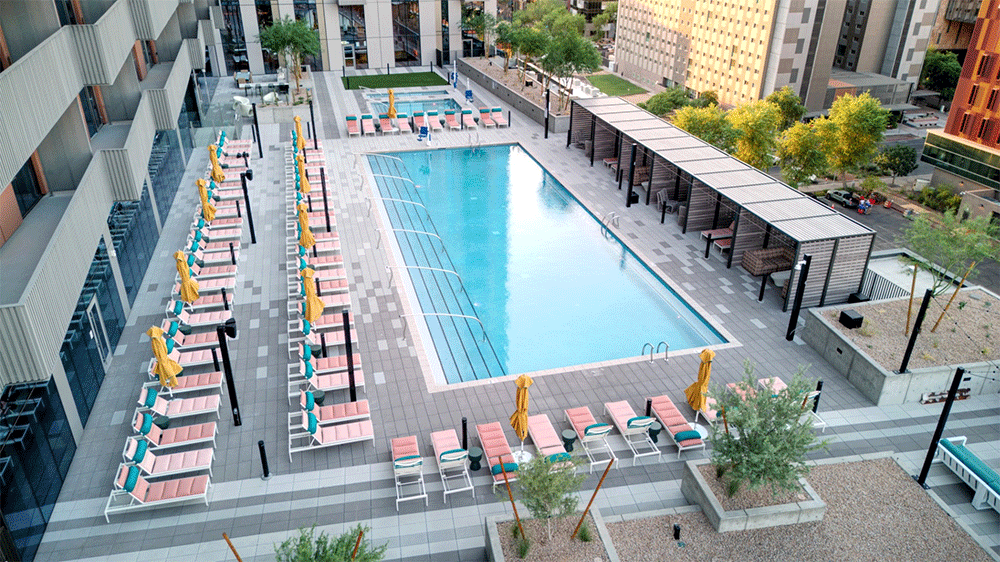
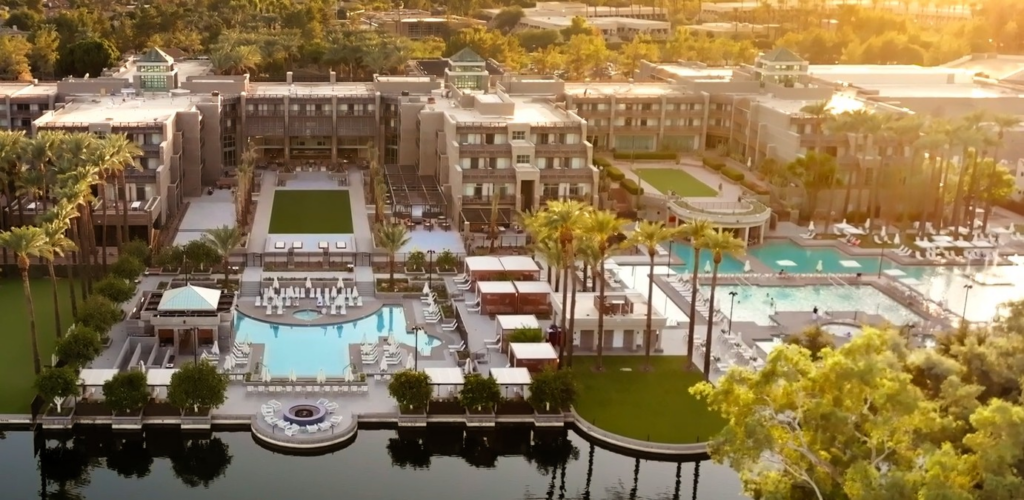
The heart of the Hyatt Scottsdale resort spans 2.5 acres and includes six pools set among raised decks, sunken lounge areas, grottos, gathering spaces, and 14 newly constructed sets of steps.

Ownership wanted a complete transformation. They wanted something cooler underfoot, visually modern, and proportionate to the grand scale of the site.

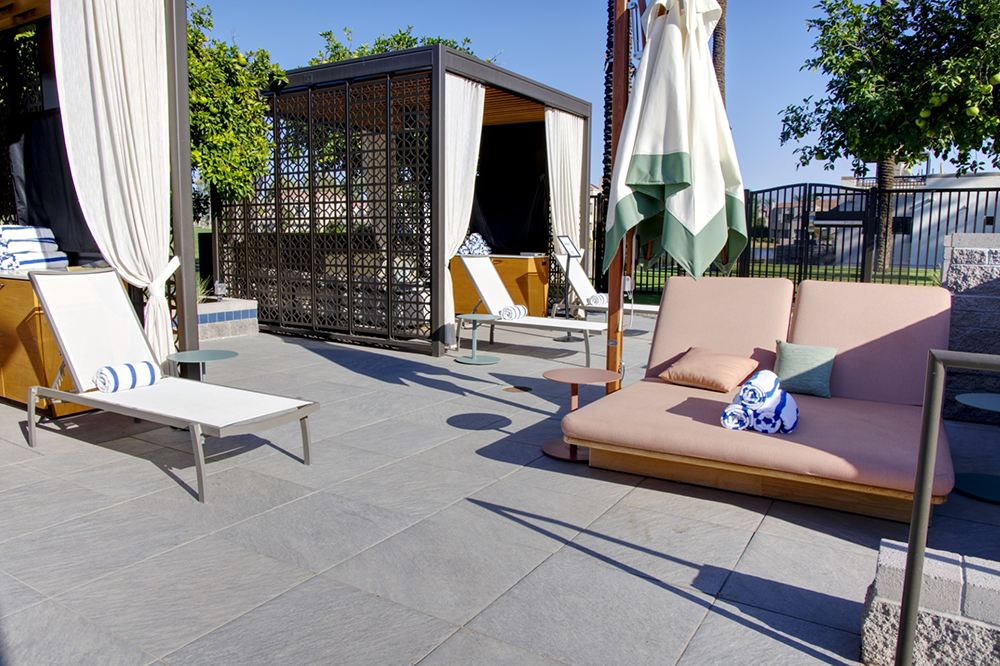
The design team selected a light-toned 24-inch by 24-inch porcelain paver laid in a stack bond pattern. The large format reinforced the openness of the space, while the clean grid avoided visual clutter. In the Arizona climate, the lighter color also reflects sunlight, helping maintain comfort around the water.

But the defining characteristic of the project was not the material alone. It was the mandate for precision.

“They wanted all the lines,” said Rex Mann, General Manager of European Pavers Southwest Inc. “It was a stack pattern, stack bond. They wanted all the lines to line up from one side of the project all the way to the other side.”

From end to end, the deck stretches roughly 125 yards. Across that distance—and over five elevation changes—every bond line had to align. Through stairs. Across transitions. Around drains.

“It took us about a week to lay it out,” Mann said.

A Compressed Timeline

Although the result feels like new construction, the project was technically a remodel. The resort intended to close in the fall and reopen in time for Arizona’s spring training season.

“We were supposed to start in October, which would have given us plenty of time,” Mann said.

Instead, the start date slipped to December. But the completion date did not move.

“So now we have to add two or three crews at a time,” he said. “It’s like trying to have two people start wallpapering a room and go opposite directions and then come together. You have to put a seam or it’s not going to line up perfectly.”

Complicating matters further were code requirements. Certain areas, particularly around food and bar spaces, required mortar-set and grouted installation per county specifications, while the majority of the project was sand-set. The team had to preserve visual continuity while shifting installation methodologies.

Drainage added another layer of complexity.

“It’s hard to tilt and manipulate 24-by-24-inch pieces of porcelain to get to the drain,” Mann said. “We had to change some other things up that we normally do.”

Yet when the project was complete, the transformation was undeniable.

“I actually read a review after the pool reopened where somebody said they give the renovated amenity area, pool decks, and pools a 10 out of 10. They recommended that people come just for the pool,” Mann said. “That was a compliment to us.”

The achievement was also lauded at the national level at the 2025 HNA Awards where it took home the top prize in the Porcelain Paver Pavement – Commercial category.

“It feels good,” Mann said. “Porcelain is an up-and-comer, surging in the market. I would say it is the fastest growing segment of hardscaping material…A lot of our workforce is older, a lot of guys have been with us 45 years. It was nice to see us take on this new material. We’re not an old dog that’s getting left behind. We’re keeping up with the times.”
Lessons for Aspiring Hardscapers

For aspiring hardscapers and crews looking to move into commercial porcelain paver work, Mann encourages them to embrace new materials instead of resisting them.

He also advises investing in the right tools and training. Large-format porcelain pavers demand precision, especially when cutting around drains, pipes, and curved elements.

“Spend the money for good tools,” Mann said. “Use the right blade. Use the right tool.”

He emphasizes building relationships with knowledgeable vendors who can guide crews through best practices.

“Align yourself with the right vendors that will help show you how to use the right tools and help you be successful,” he said. “Sometimes the right products aren’t always cheap. You may have to reach deeper to buy the right thing that’s going to make the job not only easier, but aesthetically more pleasing.”

Finally, think beyond the immediate obstacle. Large commercial jobs will test layout strategy, scheduling, and coordination. When problems arise, creativity matters.

“Anytime you’re looking at obstacles, think outside the box,” Mann said.

Across 2.5 acres of porcelain paver pavement, with six pools and multiple elevations, the Hyatt Scottsdale project demonstrates what commercial hardscaping at its highest level looks like.

The HNA award recognition validates the effort. But the real achievement lies in the discipline behind the scenes: a week of layout before the first paver was set, crews coordinating across vast distances and elevations, and a company willing to evolve with the market.
Logistics Meet Artistry in the Award-Winning North Central Project

Twenty-eight floors above Phoenix, a team of hardscapers faced a challenge that would test everything they knew about their craft.

The North Central project, which would go on to win the Segmental Concrete Pavement – Commercial (more than 15,000 sf) category at 2025 Hardscape North America (HNA) Awards, showcased the European Pavers Southwest Inc. team’s ability to come up with creative solutions for problems that don’t exist at ground level.

The Challenge of Building in the Sky

Rex Mann, General Manager of European Pavers Southwest Inc., knew from the start that this rooftop installation would demand something special. The project spanned three floors of a luxury high-rise, creating outdoor amenity spaces that would need to be as functional as they were beautiful.

“Logistics were an issue,” Mann said. “They had a tower crane, and we were only allowed so much time to get our material up there. We met that deadline, but then we ran out of floor space.”

Working on a podium deck means respecting weight limits, Mann explained. The structure can’t be point loaded, which means no double-stacking pallets. Every pallet had to be single-stacked, consuming precious square footage rapidly.

When the staging area filled up, the team had to move thousands of pavers through a freight elevator instead.

“We’re trying to move 2,500-pound pallets in an elevator, which obviously didn’t work, so we had to break them. It was a lot of labor, a lot of up and down,” Mann said. “And if you’ve never been on a construction site with elevators in a multi-family or multi-story building, there’s a lot of waiting involved.”

Different trades competing for elevator access turned material movement into a logistical puzzle.

Planning for the Invisible

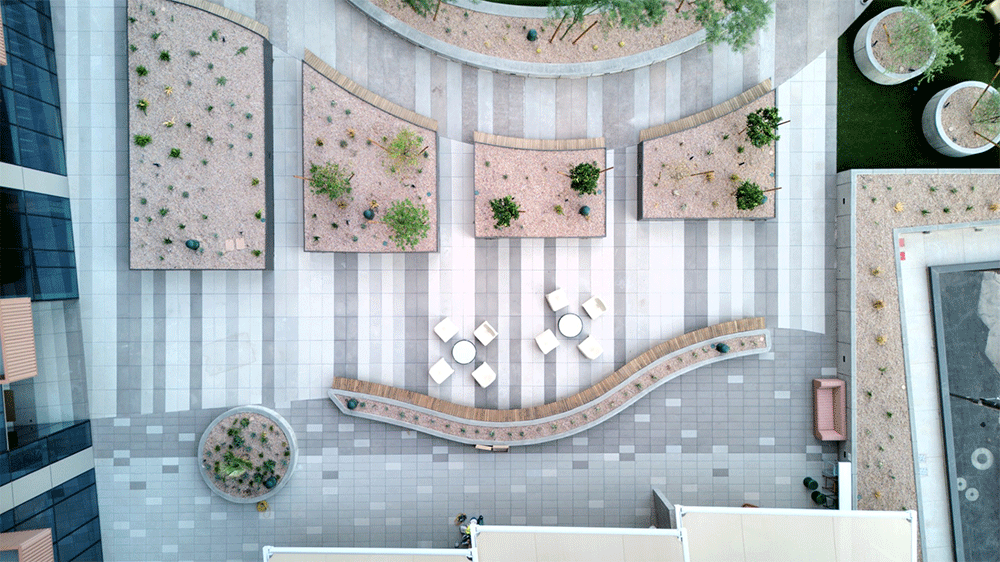
The design played with geometry and perspective, as rectilinear lines flowed parallel in some spaces, then shifted to run perpendicular in others, guiding the eye and defining distinct zones.

The smaller 12″x24″x2″ pavers were arranged in a soft gradient pattern, creating subtle movement and visual depth, while the larger 18″x36″x3″ pavers formed bold, solid bands of color that anchored the design. Carefully chosen shades of grey transformed the vast expanse into a series of engaging environments, from wide-open gathering spaces to quiet, intimate corners.

“It was a gradient pattern. There were three shades of gray. And if you didn’t have them next to each other, you couldn’t really tell which gray it was, but once they were next to each other, you could tell,” Mann said.

Where pavers met curved planters and benches, the team had to execute flawless precision cuts in those heavy slabs, shaping each curve with the patience and skill of artisans.

The design also incorporated pedestal pavers.

“The pedestal pavers are probably one of the most difficult types of pavement to install,” Mann said, “because there’s a lot of different challenges and things to overcome.”

What makes a pedestal paver installation particularly complex is that most of the real work happens below the surface. The pedestals themselves, the fiber grates, the shims, the drainage considerations—these are the elements that determine whether a project succeeds or fails, and none of them are visible in the finished product.

Starting points matter immensely in this type of work. The team had to plan not just where to begin, but where they would end, calculating how cuts would affect stability on pedestals and whether insulation adjustments would be needed. A cut that’s too small might not sit securely on a pedestal system. A poorly planned layout could create problems that only reveal themselves when you’re already committed to a direction.

‘It’s Going to Be Worth It’

“My mantra to myself is that it’s going to be worth it,” Mann said. “All this we’re going through to get to the end product, it’s going to be worth it.”

And it was.

The final North Central project was recognized locally by the Southwest Hardscape Association and earned national recognition by winning the Segmental Concrete Pavement – Commercial (more than 15,000 sf) category at 2025 HNA Awards.

“The owner, project owner and the general contractor were very happy with the finished product, as they should be,” Mann said.

“The team at European Pavers has been doing this for years. We came through with innovative ideas and teamwork and we made it successful on every level.”

Lessons for Aspiring Hardscapers

For those entering the industry or considering hardscaping as a career, Mann emphasizes the critical importance of education from trusted sources. Pedestal paver systems, rooftop applications, permeable installations, these specialized areas require knowledge that goes beyond basic installation techniques.

He recommends pursuing formal education through organizations like the Concrete Masonry & Hardscapes Association. The key, Mann stresses, is ensuring you’re learning from qualified sources with proper backing and vetted information.

“Get your education and get hands on. But make sure you get it from the right source,” he said.

Mann also offers advice on the power of teamwork and taking challenges one step at a time.

“We take it day by day,” Mann said. “We face the challenge. We conquer that challenge and we try to look ahead and see what other challenges are going to be ahead of us and we try to circumvent those when we can.”

The hardscaping industry offers diverse opportunities, from residential patios to commercial plazas to complex installations like North Central.

Each type of project demands different skills and knowledge. What remains constant is the need for proper training, commitment to quality, and the resilience to work through challenges that seem insurmountable in the moment.

When Challenges Become Features: The Story Behind an Award-Winning Amphitheater

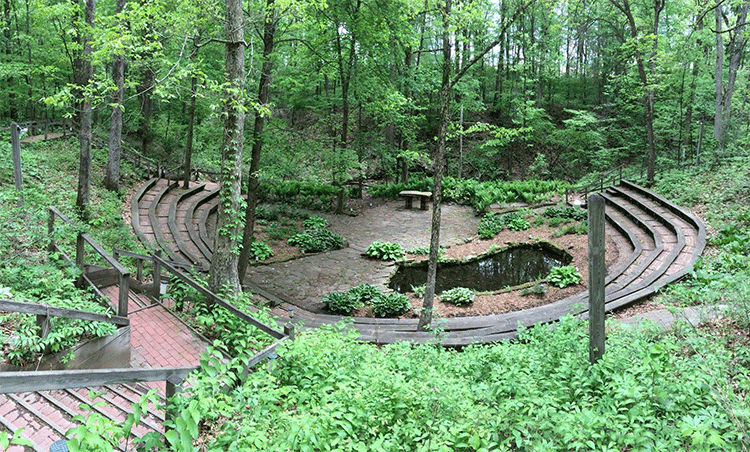
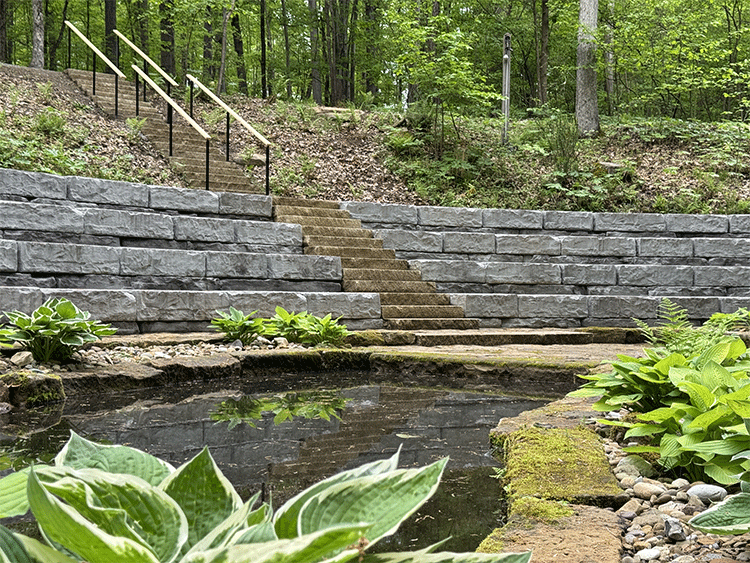
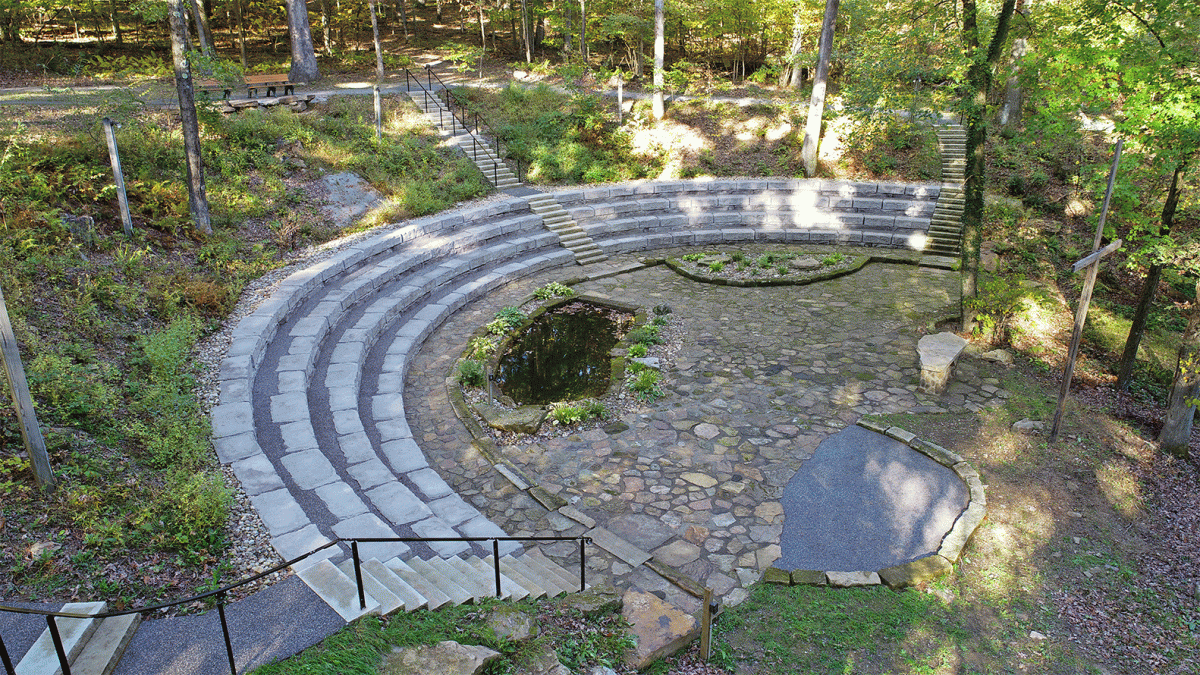
Nestled in the woods along a creek at Camp Lutherlyn in Butler, Pennsylvania, an amphitheater that has hosted generations of campers since 1980 recently underwent a remarkable hardscaping transformation.

The project, completed by Gargiulo Landscape, won the Combination of Hardscape Products– Commercial category at the 2025 Hardscape North America Awards. It was honored not just for the beauty of the final result, but for the thoughtful craftsmanship and problem-solving that brought it to life.

Honoring the Past While Building for the Future

From classes to worship services to weddings, Camp Lutherlyn’s amphitheater holds decades of memories. The donors funding the renovation had one clear directive: preserve the feeling of the place they loved.

“They wanted to keep that same feel that they had when they were there,” said Joe Gargiulo, owner of Gargiulo Landscape. “They didn’t want to make it all new and revised. They actually wanted to keep that vibe from the camp.”

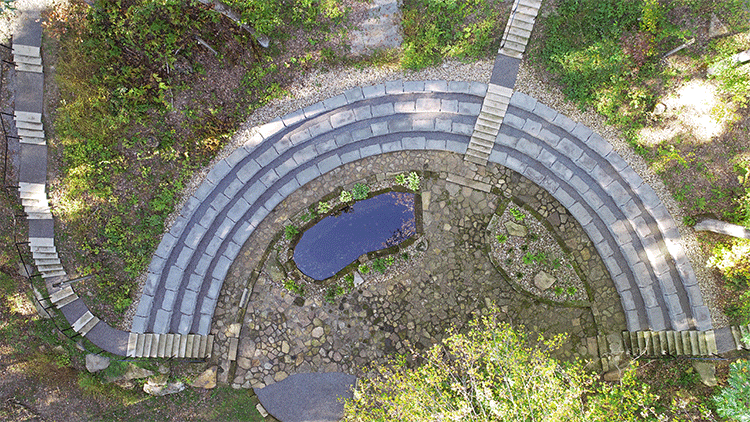
This meant working with the site’s character. The team carefully removed, cleaned, and re-laid original barnstone from the patio, preserving the rustic character while improving functionality. Even boulders were stored and reinstalled.

“This is at a summer camp and they use this area as an outdoor classroom. If it’s an outdoor classroom, it’s intended to teach kids about nature. What better way to do that to say we’re using the natural stone that was already here,” Garcia said.

But when it came to creating the tiered amphitheater seating, Gargiulo sought out innovative hardscaping options.

“We couldn’t use wood, it would go bad,” Gargiulo said. “And they didn’t want to do metal because it gets hot, it gets cold, it gets slippery.”

Instead, they needed to thoughtfully combine different materials that could help achieve both aesthetic and functional goals.

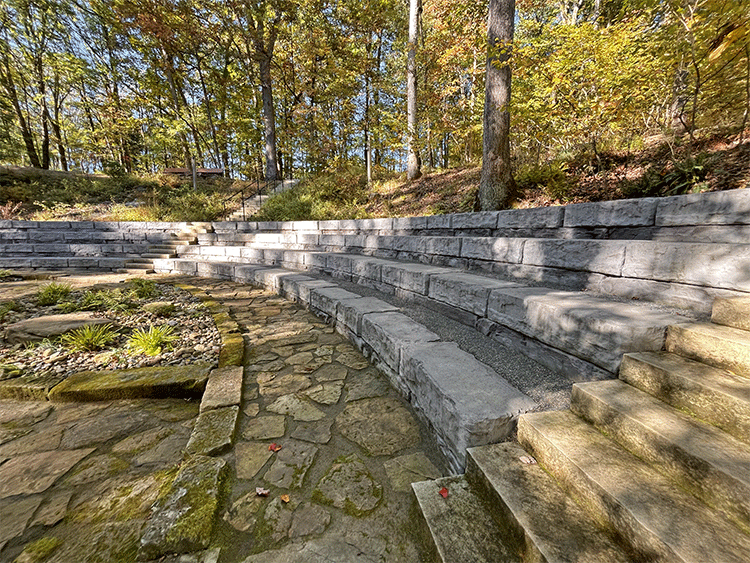
The team used R.I. Lampus Grand Ledge wetcast seating units for the tiered amphitheater seating in order to meet the site’s competing needs.

“Grand Ledge really fit that rustic feel of the campground. It’s just much easier to use in this setting because you’re married to that very consistent height and grid placement,” said Andrew Kufen, Contractor Development at R.I. Lampus.

The wetcast material also resists moss growth which was necessary for the shady, wet area.

Between the seating tiers, the team installed perkEpave, a permeable surface made from recycled rubber and gravel with adhesive binders. This allowed water to drain through rather than pooling, addressing the site’s chronic drainage issues while maintaining a natural appearance.

For the patio itself, they used resin-based jointing sand to stabilize the historic barnstone, and applied a porous binder behind each tier to create permeable surfaces throughout.

This project succeeded in part because multiple parties brought their expertise to the table. The partnership between Gargiulo, Lampus, Rosetta, and dealer Harmony Hardscape meant the contractor could try out new products, brainstorm creative ideas, and have technical support throughout the process.

“This is a very attractive project because of the setting and what you’ve built,” Kufen said. “You know that what you’ve built is going to get used and be there for a very, very long time.”

When Nature Throws a Curveball

While the project overall went pretty smoothly, the excavation process was a bit of a challenge.  But Gargiulo’s team saw this as an opportunity to demonstrate their problem-solving skills.

“Before we tore it all down, we had to keep the original material, so we had to store everything. All the flagstone was picked up by hand. Every boulder, nook, and cranny—we had to store that, clean it,” Gargiulo said.

“When we opened up that hillside a little bit, we just opened up a ton of water, so we had to focus on getting the water out and building up our foundation with a bunch of drains. It’s definitely labor intensive when you’re pulling up flagstones—they’re pretty big, you got to put them on pallets, move them, dig out the area, and then go back and relay everything. We had to redo all the bedding. We were saving as much plant material as we could. One of the biggest things was the pond. There were frogs, so we had to save all the frogs and get them out. And then of course they always came back, so we had to keep saving more frogs.”

The spring in the hillside wasn’t originally anticipated. The solution required extensive drainage work—two feet of drainstone beneath the patio, strategic piping, and a comprehensive water management system that worked with the site’s natural hydrology rather than against it.

It became a defining feature of the project. The team created a pond that naturally manages spring overflow, feeding the creek while serving as habitat for frogs and red-spotted newts. They even built steps down to the creek for campers to access the continuously running spring water.

“Being able to take and listen to what the client is seeking and being able to deliver that really goes a long way,” said Gerry Garcia, Business Consultant at Rosetta Hardscapes. “They really wanted something natural, and the Gargiulo team was able to take that request and really keep that natural feel of the environment, even though they were scared that this was a big renovation.”

Lessons for Aspiring Hardscapers

There are many lessons to be learned from an award-winning project like the Amphitheater at Camp Lutherlyn, especially for aspiring hardscapers.

Listen deeply to what your clients value. Sometimes the most important work is about understanding the emotional connection people have to a space and honoring it.

Expect the unexpected. The best hardscapers turn challenges into features that enhance the overall project. Your ability to adapt and innovate on-site can be just as valuable as your technical skills.

Material selection is about more than aesthetics. Consider durability, maintenance, functionality, and how materials work together as a system. Don’t be afraid to mix modern engineered products with natural materials when it serves the project’s goals.

Build relationships with manufacturers, suppliers, and other industry professionals. These partnerships give you access to expertise, support, and solutions you might not have on your own. Don’t try to figure everything out alone.

But Gargiulo’s most important message for aspiring hardscapers is to recognize the artistry in what you do.

” Every job is a little different, and you get new challenges, and there’s new products. You have to look at it like you’re an artist,” he says. “We go out and we rip out a whole property and we redevelop it. It’s like a blank canvas and we make a beautiful picture. We’re artists because you have to have the right eye. You’re dealing with different types of soils, and you’re dealing with water, and you’re dealing with what you’re working around. There’s a lot of components, a lot of moving things. You have to look at least five years down the road because that is what you are working for. You’re working for that longevity.”

Hardscaping requires understanding drainage, soils, elevations, utilities, materials, and how they all interact. It demands both technical knowledge and creative vision. And when done well, like at the award-winning Camp Lutherlyn, it creates spaces that will serve communities for decades.

Celebrating ‘The Baddest Home Kansas Has Ever Seen’ at the 2025 HNA Awards

“We need the baddest home Kansas has ever seen. Understood?”

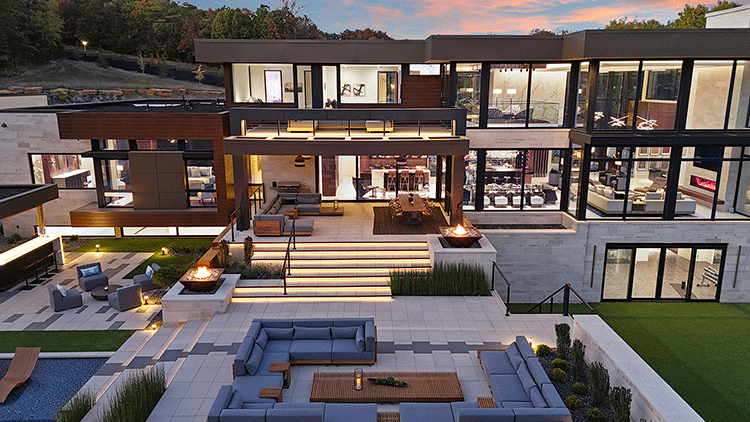
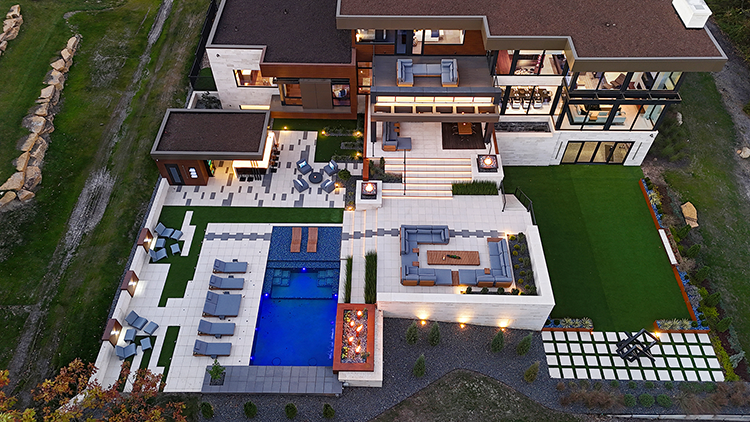
For Craig Hawkins, President of Green Lawn Inc., and his team, that client challenge would become the driving force behind a project that recently earned top honors in the Segmental Concrete Pavement – Residential – Size More than 3,000 sf category at the 2025 Hardscape North America Awards.

The award-winning project is a real-world lesson in execution, creativity, and what’s possible when ambition meets technical skills.

A Vision Takes Shape

From the very beginning, this project was about pushing boundaries. The home itself is boldly contemporary, designed in collaboration with high-end architects, and the exterior needed to match that level of sophistication.

Before a single paver was laid, Hawkins and his team invested months in careful preparation.

“There was probably a good couple months, off and on, of just reviewing plans, putting estimates together, talking to vendors, talking with architects, understanding what the intent was,” Hawkins said. “We already had the project in our mind and on paper.”

This groundwork proved essential when they finally arrived on-site.

“It’s hard when you’re looking at it on paper to really understand the scope, but it would have been impossible to walk in without all the prior homework,” he said.

The team needed to understand not just their own work, but how it interfaced with every other trade on the property, anticipating what was coming before them and what would follow after.

The design had to be a living, evolving process.

“It was a pretty unique customer,” Hawkins said. “They had a great design vision, but a lot of it was a work in progress as we went. There was a lot of collaboration that happened throughout the project trying to get everything in line with the customer’s vision.”

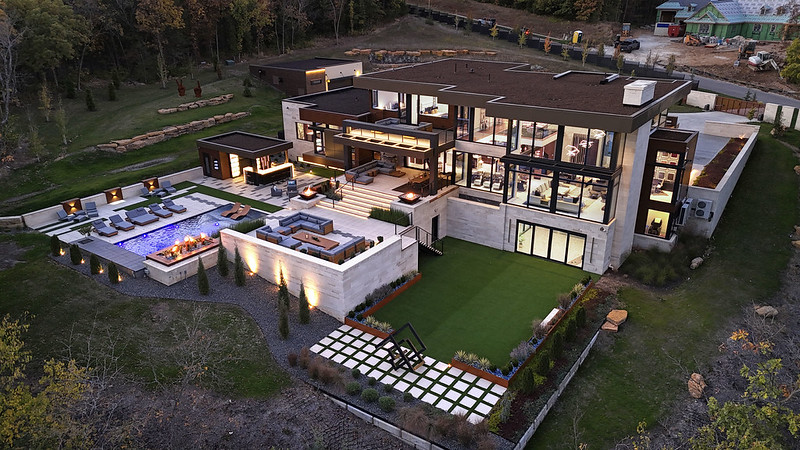
That vision was ultimately realized into a three-and-a-half-acre modern outdoor oasis.

The Scale of Ambition

The scope extended far beyond typical backyard hardscaping work. The team installed extensive drainage systems throughout the property, including sophisticated solutions for the artificial turf areas. They designed and implemented irrigation systems across the entire acreage, erected aluminum fencing around the perimeter, and tackled erosion control challenges on extreme slopes using geocells and ground cover systems.

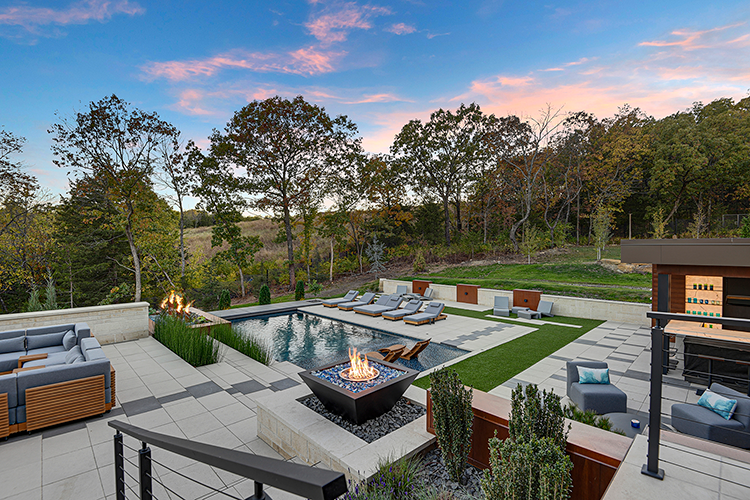
The amenities list reads like a luxury resort: fire features positioned strategically from the driveway entrance through the outdoor living spaces, patio misters for cooling, custom COR-TEN steel accent panels that rust instantly for dramatic effect, and an elaborate lighting system with hundreds of fixtures illuminating the property from dusk to dawn.

The Green Lawn team even incorporated a sophisticated softscaping plan featuring multiple seasons of color and varying textures and heights to complement the hardscape elements.

“To find all those features in one project is pretty unusual, and to do it on that scale is pretty unusual, especially in a residential setting,” Hawkins said.

The project demanded roughly a year of continuous presence on site, with crew sizes fluctuating from two members during certain phases to 10 or 12 when the bulk of installation work ramped up.

“I’m very proud of our team. They truly executed it to perfection,” Hawkins said.

Hardscaping Highlights

While the comprehensive landscape transformation was impressive, the hardscape work itself presented unique technical challenges that pushed the team into uncharted territory.

The design centered on Unilock Arcana, a large-format slab paver that was relatively new to the market. The contemporary aesthetic demanded thousands of square feet of this material in two colors: Avorio, a sophisticated cream tone, and Vivanto, a rich charcoal shade. The expansive use of Arcana created an immediate logistical challenge.
“Those colors change from run to run when a producer makes them,” Hawkins explained.

To maintain color consistency across such massive areas, the team had to source all materials from the exact same production run. Any variation would be visible once the pavers were cleaned and installed.

“If something got mixed in, it had to get torn out and redone,” he said.

The Arcana product was also so new it didn’t yet have formalized coping options. This created a significant problem for a project featuring numerous stairs, steps, and pool edges. The team had to innovate solutions on the fly.

For stair copings, they integrated the COR-TEN steel accents, finding adhesives that would bond properly to create a cohesive design element. For the pool coping, they took an even more meticulous approach, hand-painting the edges of the stone to match the top surface and maintain visual continuity.

Perhaps the most unusual innovation involved the polymeric sand used to fill joints between pavers. The client’s exacting standards extended even to this typically overlooked detail. Rather than accepting any standard color option, the team experimented with mixing multiple polymeric sand colors to create a custom color blend.

“We had Polysweep come down, and their representatives were looking at what we’re doing, and they’re like, ‘We have no idea how this will work. Nobody’s done it,’” Hawkins said. “We got concrete blenders and we’re mixing poly sand to create a color.”

Corinna Fell Napolitan, who designed the project with Hawkins, echoed this commitment to the precision required.

“We had a lot of unforeseen issues and we worked through that,” she said.

High-end projects like this demand an obsessive level of detail, especially when working at scale. Small inconsistencies become glaring when repeated across expansive surfaces.

Lessons for Aspiring Hardscapers
For those entering the hardscaping field or working to advance their careers, this project offers valuable insights.

For Hawkins, the biggest takeaway is the process, not just the final product.

“Never stop learning,” he said. “There was stuff we learned throughout this project. If we had walked away thinking it was too hard or too complex, we would have left with a lot less knowledge.”

He also emphasizes the importance of leaning on your team and your vendors, and not being afraid to take on projects that stretch your current skill set.

“Don’t be afraid to take on something challenging,” Hawkins said. “That’s how you grow as a professional in this industry.”

“Don’t be afraid to think outside of the box,” Fell Napolitan added.

Winning with Attitude

Receiving national recognition at the HNA Awards brought a deep sense of validation for the entire Green Lawn Inc. team.

“It was really rewarding and gratifying,” Hawkins said. “I felt a big sense of accomplishment for my team. To be on a national platform and be recognized is a great feeling.”

But Hawkins said their greatest achievement was the satisfaction of meeting a “very discerning” client’s expectations flawlessly.

“My team did exactly what they had to do to make that client happy,” Hawkins said. “That’s probably what I’m most proud of, that the client was happy, satisfied, never regretted any step of the process.”

When the project was submitted for the HNA Awards, it carried the same name the client gave it from day one: The Baddest Home Kansas Has Ever Seen.

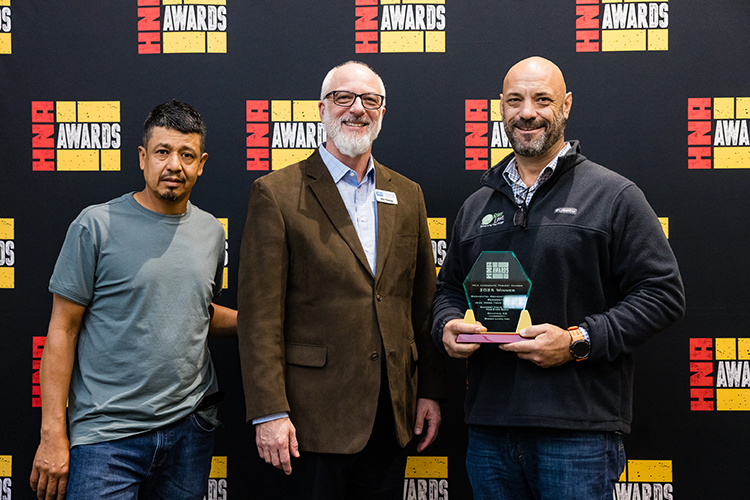
“When they handed me the award, they said, ‘That’s winning with attitude,’” Hawkins said. “And I wanted to tell him it wasn’t mine—it was the customer’s.”

The Baddest Home Kansas Has Ever Seen stands as a testament to what’s possible when vision meets skill, when preparation combines with adaptability, and when teams commit fully to excellence.

Whether you’re just starting your career or looking to take on more complex projects, remember that today’s impossible challenge becomes tomorrow’s award-winning achievement when approached with the right mindset and dedication.

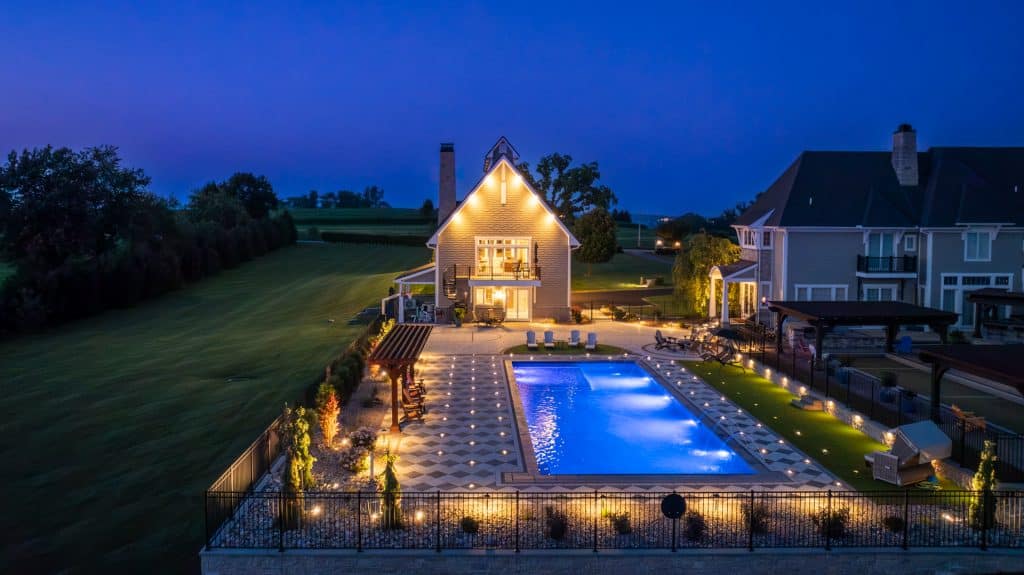
Ultimate Backyard Lancaster: A ‘Once-in-a-Career’ Hardscaping Project

Jeremy Martin, owner of Willow Gates Home & Landscape, first received a call from his client about the “Ultimate Backyard Lancaster” project in summer of 2023. Martin was on vacation at the time, but he was so intrigued by his client’s description of their dream project that he felt compelled to respond immediately.

“It was the kind of project that comes along maybe every 10 years, maybe once in a career,” Martin said.

Ultimate Backyard Lancaster would eventually go on to win the Segmental Concrete Pavement – Permeable category and earn an Honorable Mention in Outdoor Living Features category at the 2025 Hardscape North America Awards.

But the Ultimate Backyard Lancaster isn’t just an award-winning project. It’s proof that even the most ambitious visions can become reality when every detail is treated with care.

Building a Dream

Martin’s client had been planning this project since 2015, when he first built his home. By the time he reached out to Martin, the architectural drawings for the entertainment barn the project included were mostly complete, but the real work was just beginning.

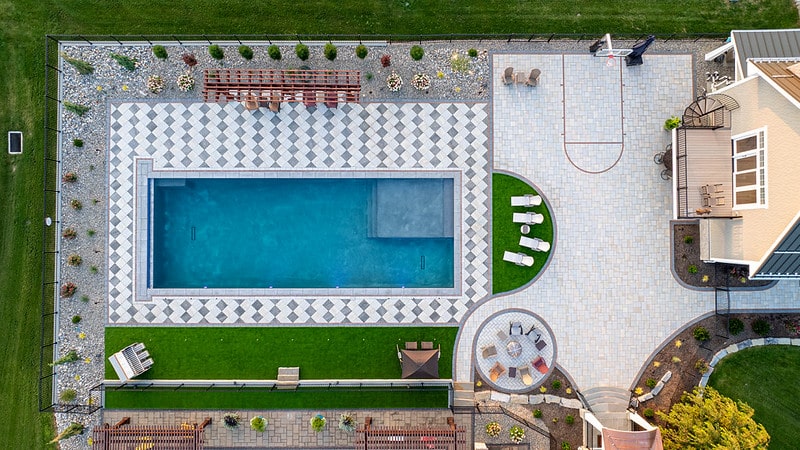
Martin thinks and designs in 2-D. For this project, he started with the two largest features: the barn footprint and the pool dimensions. From there, he built outward, carefully considering how each element would flow together.

In addition to the barn and pool, the client also initially requested a full half-court basketball court. Once Martin showed him what that would require, they scaled back to free throw lines and other basketball court elements so the final look would still be impressive, but not overwhelming.

Finding the Right Materials

“One of the guiding principles was this had to look like it’s built at the same time as the home, despite being 10 years later,” Martin said.

That guiding principle would shape every design decision for Martin.

The property also already featured outdoor living space built in 2017, complete with a bocce court and outdoor kitchen. Rather than forcing a perfect match with the older materials, Martin took a thoughtful approach.

All retaining walls and the barn used a natural stone veneer that matched the outdoor kitchen and closely coordinated with the house. This created cohesion instead of contrast.

“I really hated the idea of adding in yet another color, another texture,” Martin said. “I didn’t want it to be a complete fruit salad of everything thrown in there.”

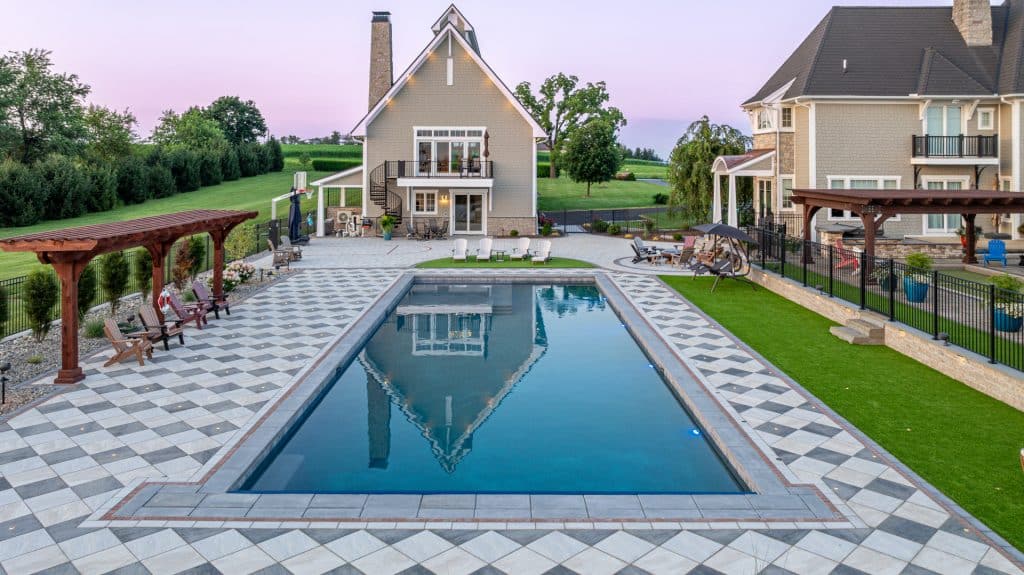
For the pool patio, the client fell in love with the texture of Techo-Bloc’s Everest paver and wanted it in a diamond pattern using three colors: very dark gray, light gray, and medium tan.

When the client initially requested mixing all three colors in three different sizes throughout the large patio in addition to the pool, Martin pushed back.

“I said, ‘That’s just way too busy. We need to dial it back,’” Martin said.

Instead, Martin used the same color palette in much more muted tones—very light gray, very light cream, and very light tan—for the main patio. The result was visual interest without overwhelming the massive space.

“I love it. I think that really brought it all together. Those colors came together perfectly,” Martin said.

Sweating the Details

The curves in this project stand out as the most challenging and rewarding elements for Martin.

Martin wanted the semicircle at the shallow end of the pool, a curved walkway, and a circular fire pit seating area to flow together perfectly. He spent hours during the design phase ensuring these curves aligned, then duplicated that precision in the field.

“Those are the little details that I really sweated,” he said. “They were really important to me, and you’re like, ‘is it really worth it?’ You look at a picture at the end, and, yes, it was worth it. Those curves all are pretty much perfect.”

The same attention to detail extended to the diamond pattern around the pool. Martin designed the borders and everything to work with full and half diamonds—no slivers anywhere. All four sides were laid out meticulously to avoid any partial cuts.

The Permeable Challenge

Adding nearly a quarter acre of impervious surface in Pennsylvania’s Chesapeake Bay watershed meant serious stormwater management requirements. The project needed a 100-year stormwater plan capable of storing 7.5 inches of rainfall.

The solution required making the entire patio and all artificial turf areas permeable with a 20-inch base.

“It’s kind of crazy. We didn’t need that much base, it’s simply a patio, but we had to store 7.5 inches, and that’s what it came out to be,” Martin said.

The team also constructed a massive infiltration bed measuring 30 feet wide by 90 feet long and 30 inches deep for the barn, driveway, and other improvements.

“Permeable truly does make sense. It’s good stewardship. It’s good management, and given you’re building a patio anyway, we’re already putting a base in. To make it deeper and put stormwater management underneath it just makes sense in a lot of cases,” Martin said.

A Year in the Making

From initial contact with the client to getting permits in hand took a full year. Stormwater planning alone consumed over half that time.

Installation continued right up until winter arrived, with the team working as snow was flying and temperatures dropped into the teens.

But the most rewarding moment came during installation. Martin arrived one Saturday to find his client playing basketball with his granddaughter on the not-quite-finished court.

“This really kind of encapsulated why he wanted to build this. It’s for his family and his friends. It’s not a public space, he’s not renting it out, this is just a place for him to hang out with his friends and family,” Martin said.

“It’s easy to lose sight of that when you’re building something this over the top, but at the end of the day, that’s what it’s for. He’s hosting people there constantly, family, friends, board meetings. He built this place to be used. It’s not just something to show off with. This is a place he wanted to use, and he is. He’s using it all the time.”

Details Over Scale

The scale of this project is staggering. More than 4,500 square feet of pavers isn’t something you see often.

“Everyone who’s seen this project is kind of mind-boggled by the sheer scope,” Martin said. “I do view it as very much a privilege and an honor to be able to build this for the client.”

Winning in two categories at the 2025 HNA awards validated all the hard work Martin and his team put into the project. For aspiring hardscapers who want to one day work on their own award-winning projects, Martin encourages them to focus on the details, not just the scale.

“Details matter,” Martin said. “Just the sheer scope of a project or sheer scale isn’t really the most important thing. So yes, this is an amazing project, a once-in-a-lifetime project that I never even would have dreamed of. But it’s really the little details that matter, whether it’s a big project or a small project.”

He points to the clean diamond pattern around the pool, the perfectly flowing curves, the muted and coordinating color palettes. These are the elements that elevate good work to exceptional work.

“If you lay a 5,000-square-foot patio and there’s no character to it, the joint lines aren’t straight—you missed the point, you know?” Martin said. “I don’t want to do that kind of work. To me, it’s not the sheer size. I care about the details.”

His client’s decade-long dream is now a showcase of what’s possible when scale meets meticulous hardscaping craftsmanship.

How Smart Hardscaping Solutions Solved Big Challenges at America’s Most Famous Battlefield

When visitors arrive at Little Round Top in Gettysburg National Military Park, they’re stepping onto hallowed ground.

But with over a million visitors each year, the site – one of the most pivotal sites of the Civil War – needed infrastructure upgrades that could handle massive foot traffic while respecting the history beneath their feet.

For aspiring hardscapers, this innovative retaining wall project that won top honors at the 2025 Hardscape North America awards offers lessons in innovative problem-solving, adaptability, and delivering results under unique constraints.

Creatively Preserving a Historical Site

The parking area at Little Round Top’s summit needed a retaining wall to raise the slope’s grade and improve traffic flow, creating safer gathering areas and better accessibility for tour buses. But its status as a historical site created additional challenges.

“You want to be very respectful of the history of sites like this, and preserving as much of the natural landscape as possible,” said Dave Belyea, Communications & Global Events Manager at CornerStone Wall Solutions Inc.

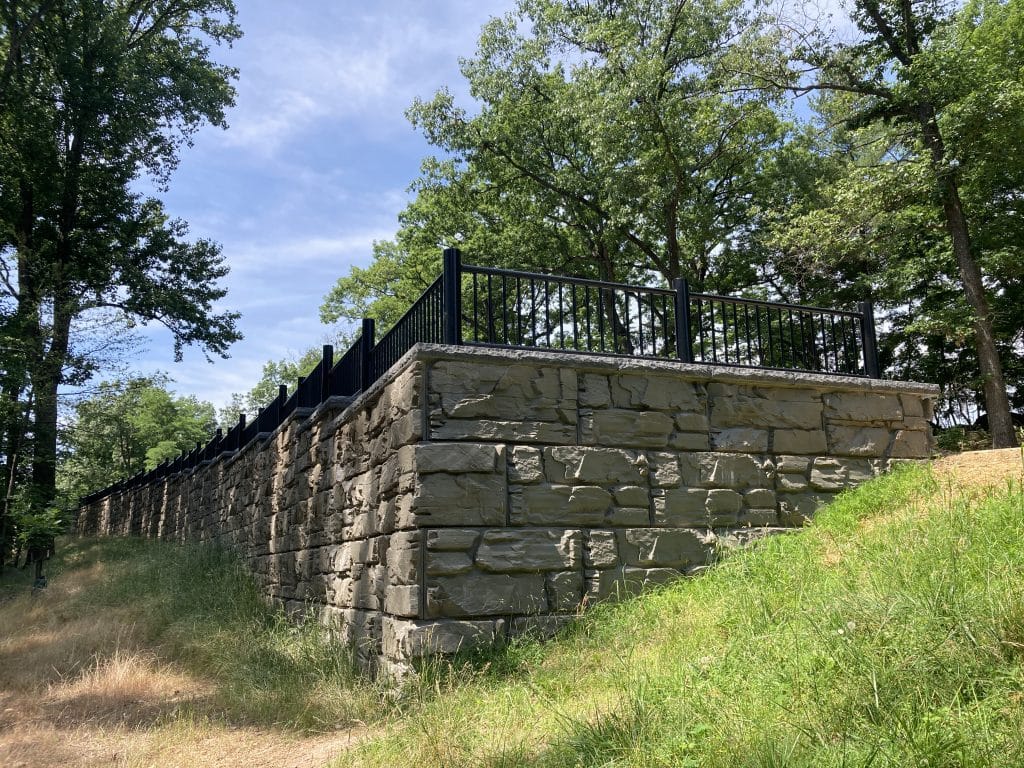
The original specifications called for a geogrid-reinforced granite boulder wall, but sourcing materials proved difficult. That’s when contractor Structural Engineering Group (SEG) and ELA Group, the project engineer, approached York Building Products about an alternative solution using MagnumStone blocks.

The blocks were ultimately chosen because one of MagnumStone’s signature features are gravity extender units. These components work similarly to geogrid but require significantly less digging. On a historic battlefield where every shovelful matters, this was crucial.

“With less excavation, MagnumStone’s gravity wall system delivers more solutions for common and complex retaining wall projects,” Belyea said.

The hollow core blocks could also be handled with compact construction equipment. This eliminated the need for large staging areas, which worked particularly well for the constrained spaces atop the storied Battle of Gettysburg hillside. 

“Small crews are capable of these projects too,” Belyea said. “You can have crews with as little as 2 to 3 people installing well over a thousand square feet of block per day.”

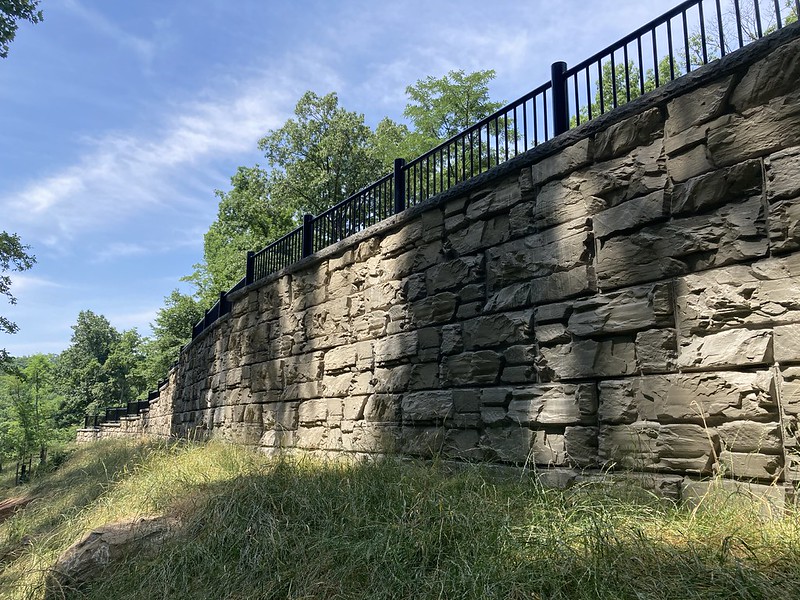
The National Park Service also had specific visual requirements for the site. The team used MagnumStone’s natural ledge face texture on one side of the parapet wall, then attached granite-colored stone veneer to the parking lot-facing side to achieve the desired ashlar pattern. The blocks were stained to match the region’s natural granite color palette.

“It was a really neat way of integrating different hardscaping products to come out with an end product that achieved the structural requirements, long-term stability, and durability required for a historic site with that much traffic, but also the look they envisioned,” Belyea said.

Award-Winning Results

The completed wall reaches 10 feet at its highest point and covers 3,485 square feet, with a hybrid gravity and parapet design. The top courses were filled with concrete to support safety fencing, with posts installed directly into the blocks’ hollow cores for a clean, elegant finish. It also features built-in lateral and vertical drainage channels for superior drainage.

The end result supports active pressures from the roadway and offers a new sidewalk and gathering areas for loading and unloading tour buses.

“Everyone was thrilled with the construction efficiency and the system’s history of performance,” Belyea said. “It looks natural, clean, elegant and fitting of this historic site. The end product was a retaining wall the National Military Park can be proud of, enhancing the safety and experience of tourists who visit from coast to coast or internationally.”

The Little Round Top project was recognized at the 2025 Hardscape North America Awards, taking home the top prize in the Commercial Retaining Wall category.

“It’s nice to showcase what our products can do. It’s an honor to be recognized with an HNA Award for our products and their capabilities. We have an excellent network of production partners and we want to help share their hard work,” Belyea said.

“Seeing the teamwork that goes into all of these projects is special, from consistent block production to scheduling site material deliveries and the creativeness of the engineers and contractors involved to seek out solutions like our gravity extenders. The gravity extenders fit the needs of the project, and resulted in a successful, long-term solution. It’s rewarding to see the full circle moments that come out of it all.”

Lessons for Aspiring Hardscapers

There are many lessons to be learned from an award-winning project like Little Round Top, especially for aspiring hardscapers.

Stay open to alternatives. When the original specifications proved difficult to source, the team didn’t give up. Instead, they proposed an innovative solution.

Efficiency matters. The gravity wall approach with extender units greatly minimized excavation depths compared to alternative solutions, saving time and money while reducing environmental impact.

Small crews with the right tools and systems can tackle impressive installations. This project was possible because the products it used meant they could use compact equipment.

Think about the full picture. This project succeeded because it addressed multiple needs: structural requirements, time constraints, budget considerations, aesthetic demands, and environmental preservation. Great hardscaping is about building something that works on every level.

With Little Round Top, MagnumStone, York Building Products, Structural Engineering Group, and ELA Group crafted work that will stand the test of time, serve its purpose beautifully, and make everyone involved proud of what they’ve accomplished together.

Transforming Public Spaces: Inside European Pavers Southwest’s Award-Winning Hardscape at Scottsdale Civic Center Plaza

The Scottsdale Civic Center Plaza, a nine-acre public gathering space in downtown Scottsdale, Arizona, has been a community cornerstone for over 50 years. As part of a $27.5 million bond-funded renovation, the plaza underwent a complete overhaul to modernize its infrastructure and aesthetics while enhancing its year-round usability.

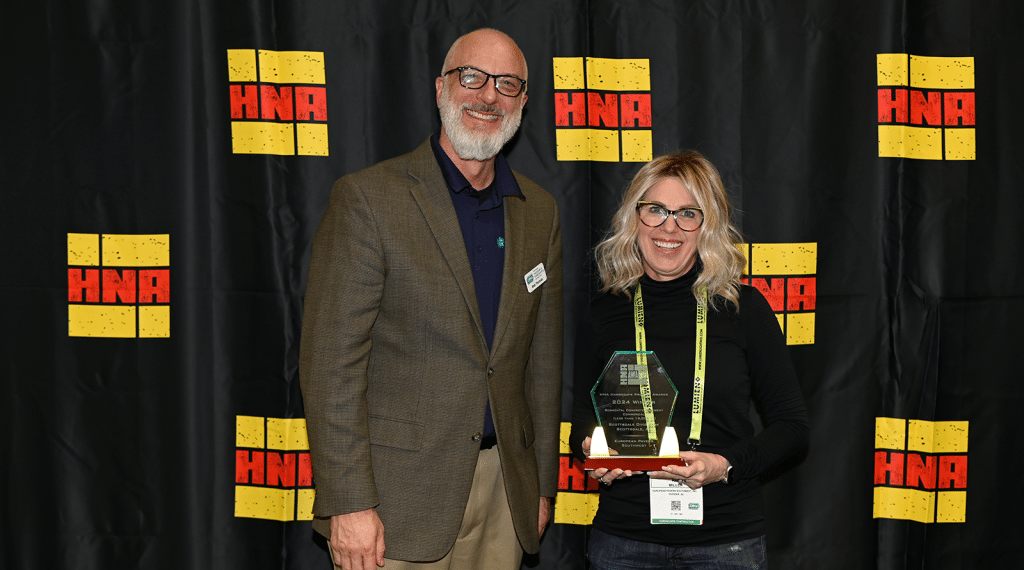
European Pavers Southwest played a crucial role in transforming this urban oasis, earning national recognition for their work. Their efforts were celebrated at the 2024 Hardscape North America (HNA) Awards, where they took home the top prize in the Segmental Concrete Pavement – Commercial (less than 15,000 sf) category. The event recognized outstanding hardscape projects from 215 submissions across 19 categories.

European Pavers has built up a reputation for municipal work, especially in Arizona, and she was thrilled when they were selected to take on this Scottsdale project.

“It was a huge project,” Kimberly Miller, President of European Pavers Southwest, said. “It’s our reputation. We’ve been here for so long in Arizona and throughout the Southwest. People know our workmanship. They know that we return our phone calls. They know we show up for punch lists. They know we’re honest,” Miller said.

Reimagining an Iconic Public Space

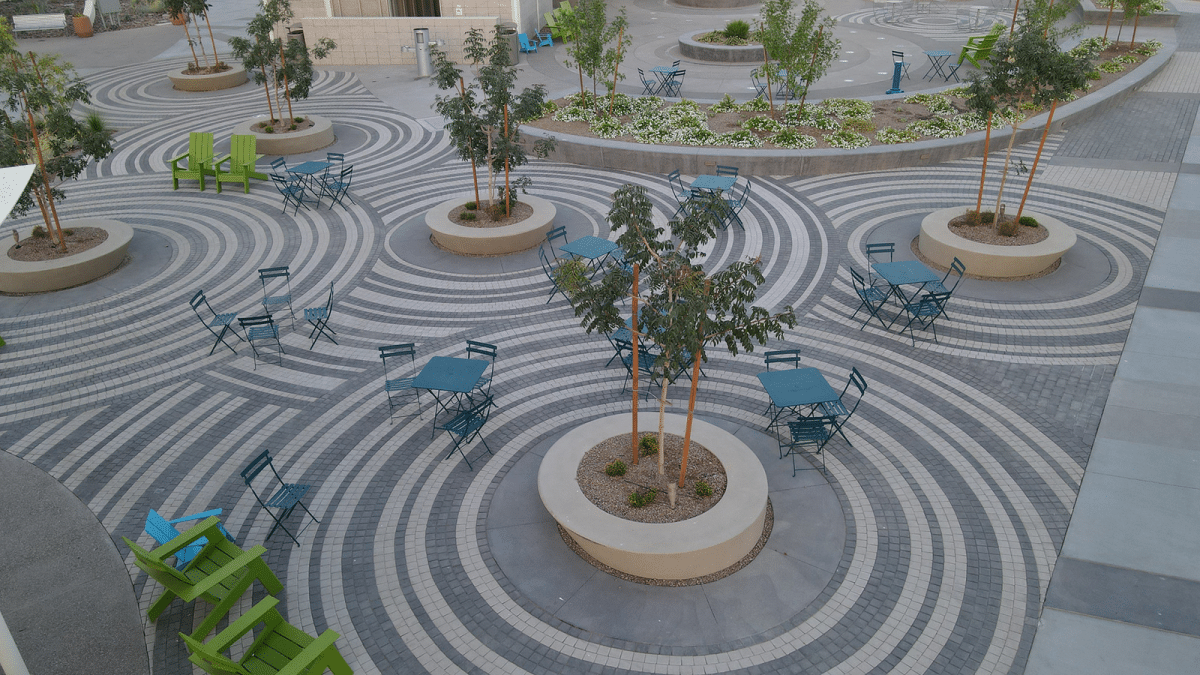
Scottsdale Civic Center Plaza consists of nine acres of pristine open public space constructed over 50 years ago in the heart of downtown Scottsdale, Arizona. With a bond-funded $27.5 million budget, the Civic Center Plaza Renovation Project included upgraded utilities, regraded and drained landscapes, and newly installed hardscapes. Key additions include two multi-functional stages, restroom facilities, a children’s play area with a mist-fog system, and expansive pedestrian walkways designed with eye-catching pavers. 

European Pavers Southwest worked on four distinct areas of the revamped plaza. Their award-winning section spans 4,800 square feet and showcases an intricate series of concentric and patterned circles crafted with various types of stones and permeable pavers.

The project took about four weeks to complete. The visually striking design required technical precision, expert craftsmanship, and honest feedback. These are the qualities that have built the company’s impressive reputation throughout Arizona and the Southwest.

Crafting for Community Impact

Miller finds deep satisfaction in contributing to public works that the entire community can enjoy.

“I love those jobs because they’re so high profile,” she said. “It’s something that somebody’s going to see.”

The plaza’s pavers, supplied by Ackerstone, perfectly complemented the design vision crafted by the City of Scottsdale. This collaborative effort highlights how hardscaping goes beyond construction—it’s an art form that can redefine public spaces.

With a complete overhaul, the site’s new layout is designed so that all nine acres of the plaza can be utilized throughout the year. The existing hardscape was removed, and an extensive grading operation lowered the grade by as much as six feet in some areas. Several hills were moved to enhance the view of the park. New decorative hardscape and pedestrian walkways—a combination of concrete and pavers—made this linear civic space more inviting to users and visitors. 

A Surprising Win

With 215 project submissions across 19 categories, the 2024 Hardscape North America (HNA) Awards showcased hardscaping excellence in materials such as concrete pavers, clay bricks, retaining walls, adhered thin veneers, porcelain, natural stone, and vintage installations.

European Pavers Southwest took home the top prize in the Segmental Concrete Pavement – Commercial (less than 15,000 sf) category for its work on the Scottsdale Civic Center Plaza.

Despite their stellar work, the European Pavers team was genuinely surprised when their project was announced as the first-place winner.

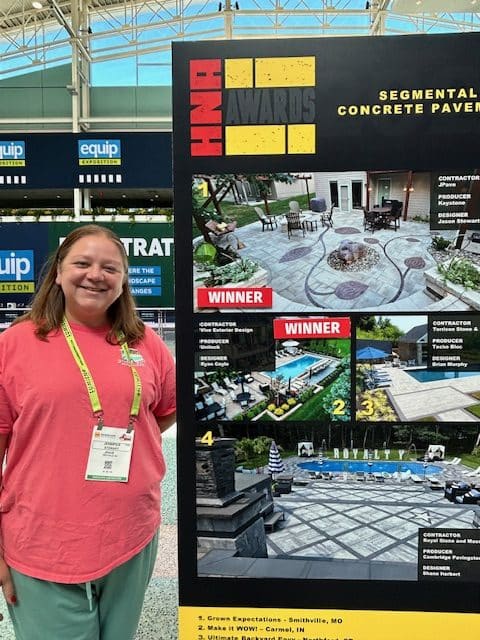
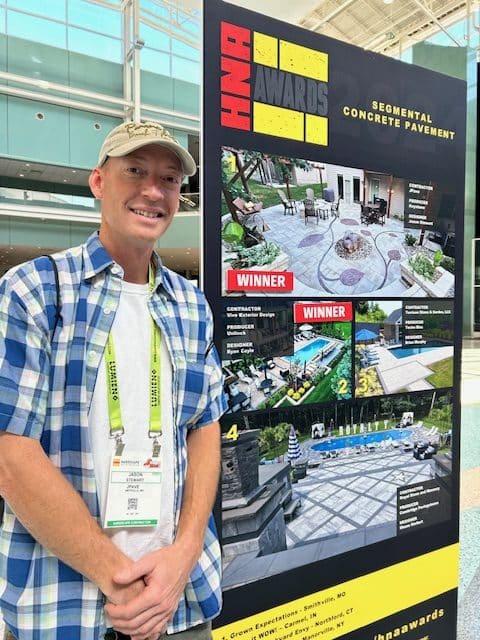
Because of the way they saw the boards displayed at HNA, they thought they had gotten fourth place and the photos were just being shown as additional project examples.

“Needless to say, we were all shocked!” European Pavers posted on Facebook with the announcement of their win.

Inspiring the Next Generation of Hardscapers

European Pavers Southwest’s success at the HNA Awards proves that hardscaping is more than laying stones—it’s about shaping environments, telling stories through design, and leaving lasting legacies.

For aspiring hardscapers, projects like Scottsdale Civic Center Plaza show how creativity and craftsmanship can blend into something truly remarkable.

As Miller summed up, “We take pride in what we do. Saying I’m proud of my team is an understatement.”

Inspiring Artistry and Creativity in Hardscaping: Lessons from JPave’s Award-Winning Project

Breaking into the hardscape industry can feel like a big leap, but the recent 2024 Hardscape North America (HNA) Awards was a reminder that great things come from creativity, passion, and a willingness to push boundaries. With a remarkable 215 project submissions across 19 categories submitted in 2024, the competition highlighted the creativity and expertise within the field.

Among the standout projects was one that should especially inspire newcomers to the field: JPave’s “Grown Expectations,” a residential patio that redefines what’s possible in small spaces.

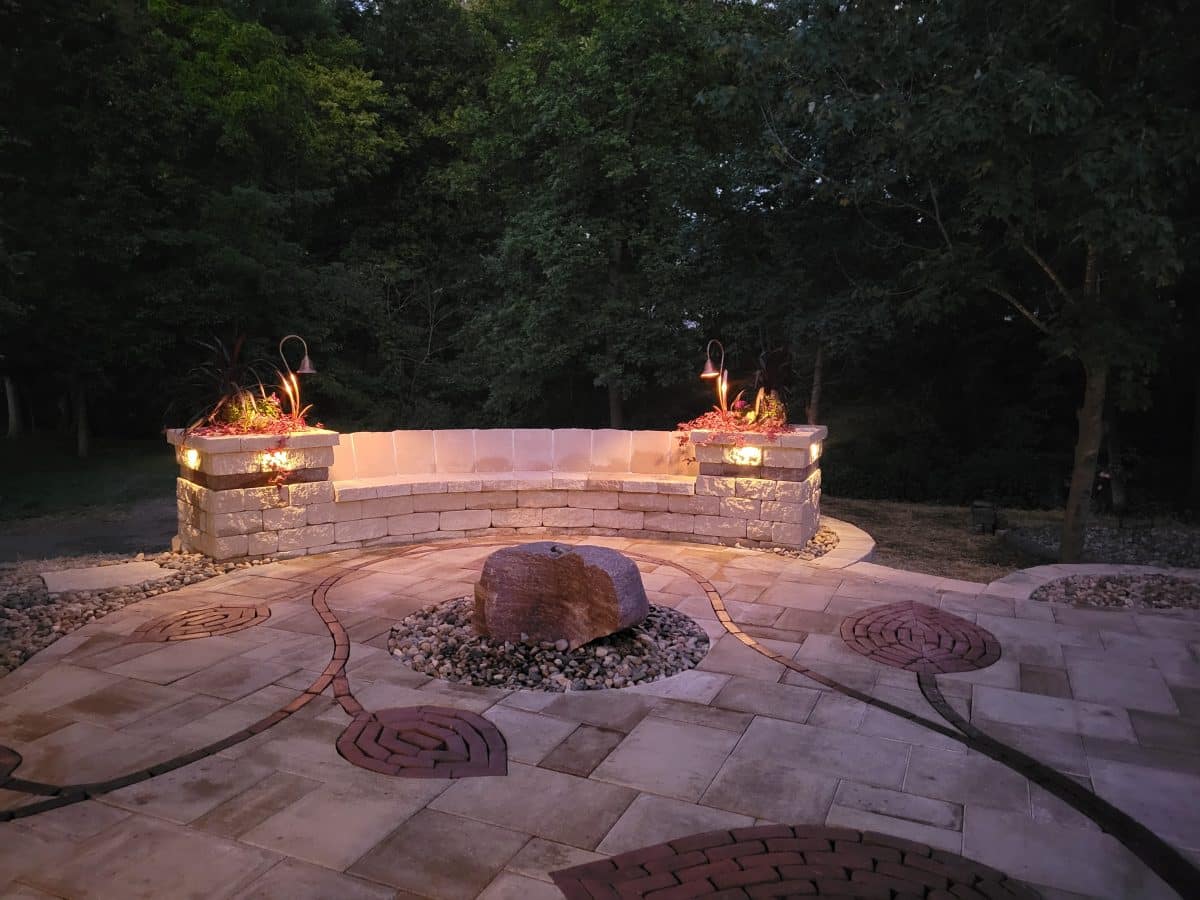
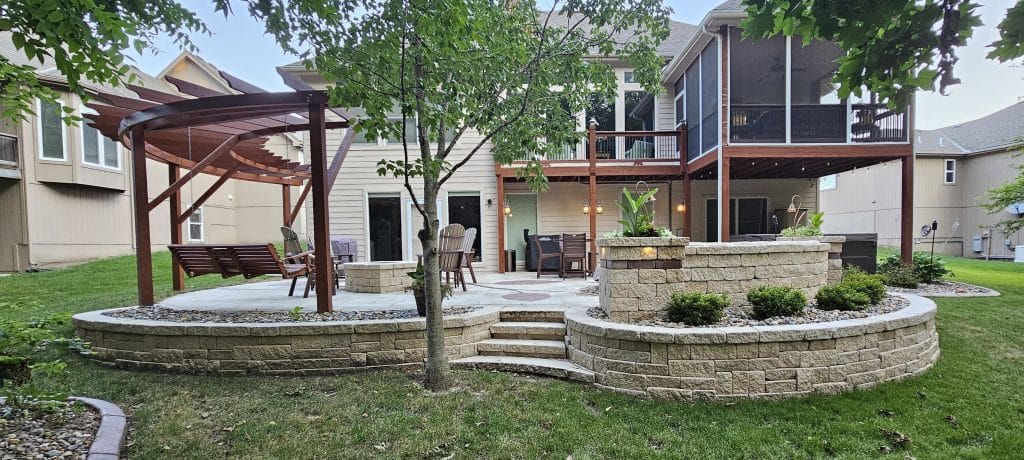
Jason and Jennifer Stewart, owners of JPave in Smithville, MO, took home top honors in the Segmental Concrete Pavement – Residential (less than 3,000 square feet) category. Their award-winning patio design used a combination of brickwork and pavers to create the impression of a vine weaving through the space, connecting a pergola, firepit, water feature, and dining area.

For Jason Stewart, this design was a long time in the making.

“I actually designed a variation of that idea for two prior customers, but nobody ever wanted it until this customer. I think with this particular project, the space that was allowed, the things they already had in place, and what they wanted and requested, it just flows so beautifully,” he explained.

For those new to the industry, Jason’s experience highlights the importance of finding a balance between artistic vision and customer needs. It’s all about understanding your clients’ preferences and finding creative ways to bring those ideas to life. This project, for instance, stayed true to the home’s overall aesthetic.

“It was a traditional design. The home is a traditional home. The front is all red brick, so it definitely matched the style of the home,” Jason shared. “I did present two other ideas that were more modern and contemporary designs to the same customer, and this is what they chose.”

For anyone starting out, one of the most inspiring aspects of “Grown Expectations” is the way it combines so many skills, including hardscaping, carpentry, boulder coring, lighting, wall building, staining, and even some coppersmithing. Jason’s advice? Don’t shy away from challenges.

“Since I was the installer and the designer, I knew my capabilities,” he noted. “Don’t be afraid to design and install. We did have to do a lot of stuff here. That wasn’t all interlocking pavement. There were water features, electrical pumps. There’s a curved pergola in it where there’s actually carpentry and woodwork. There are walls in there.”

Jennifer added, “Don’t be afraid to try the hard stuff. He knew it was going to be difficult, and that execution was going to be different and one of a kind, and he was not afraid of it. He went in full force and just knocked it out of the park.”

The Stewarts hope this recognition will open doors for new design opportunities and inspire others in the hardscaping community to explore their creativity.

“I’m hoping to gain more design work off of it,” Jason said. “We definitely wanted to show what you can do with a small space and it doesn’t look crowded at the same time… You could scoot the table and chairs out of the way, and it could be a dance floor for sure.”

Whether you’re just starting in the hardscaping field or looking to push your designs further, remember that every project is an opportunity to learn, innovate, and inspire. JPave’s “Grown Expectations” is proof that with a clear vision and a fearless approach, you can create spaces that not only stand out but also resonate with your clients and bring their dreams to life.

GET STARTED WITH A CAREER IN HARDSCAPING TODAY!