Twenty-eight floors above Phoenix, a team of hardscapers faced a challenge that would test everything they knew about their craft.
The North Central project, which would go on to win the Segmental Concrete Pavement – Commercial (more than 15,000 sf) category at 2025 Hardscape North America (HNA) Awards, showcased the European Pavers Southwest Inc. team’s ability to come up with creative solutions for problems that don’t exist at ground level.
The Challenge of Building in the Sky
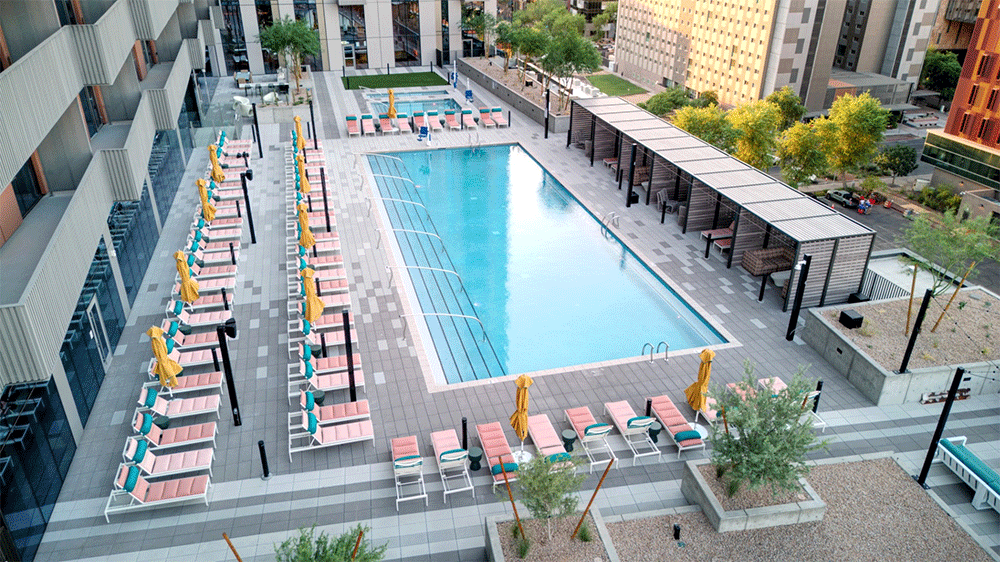
Rex Mann, General Manager of European Pavers Southwest Inc., knew from the start that this rooftop installation would demand something special. The project spanned three floors of a luxury high-rise, creating outdoor amenity spaces that would need to be as functional as they were beautiful.
“Logistics were an issue,” Mann said. “They had a tower crane, and we were only allowed so much time to get our material up there. We met that deadline, but then we ran out of floor space.”
Working on a podium deck means respecting weight limits, Mann explained. The structure can’t be point loaded, which means no double-stacking pallets. Every pallet had to be single-stacked, consuming precious square footage rapidly.
When the staging area filled up, the team had to move thousands of pavers through a freight elevator instead.
“We’re trying to move 2,500-pound pallets in an elevator, which obviously didn’t work, so we had to break them. It was a lot of labor, a lot of up and down,” Mann said. “And if you’ve never been on a construction site with elevators in a multi-family or multi-story building, there’s a lot of waiting involved.”
Different trades competing for elevator access turned material movement into a logistical puzzle.
Planning for the Invisible
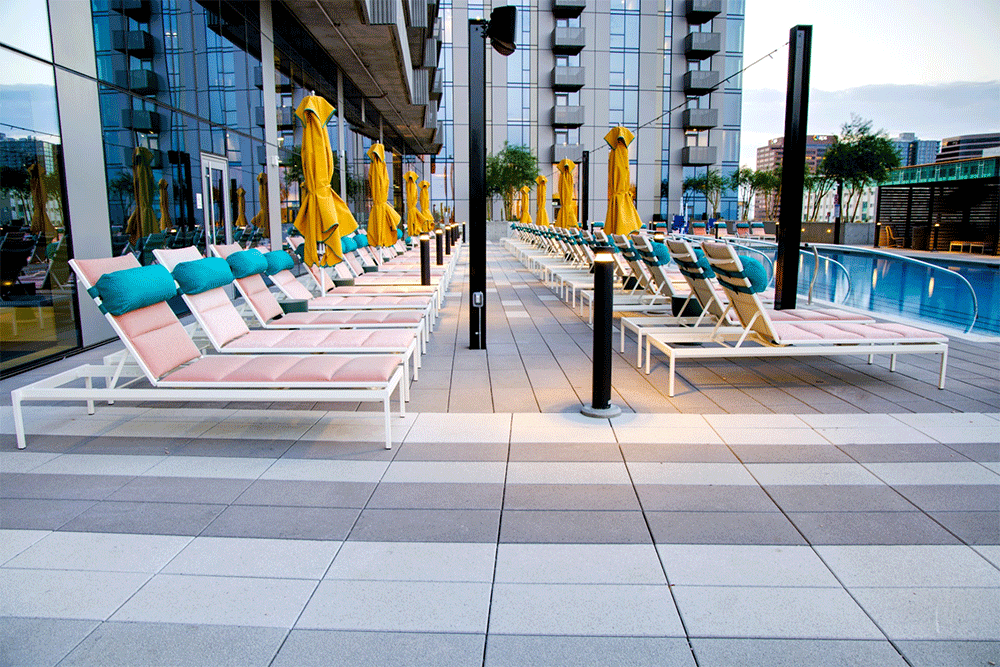
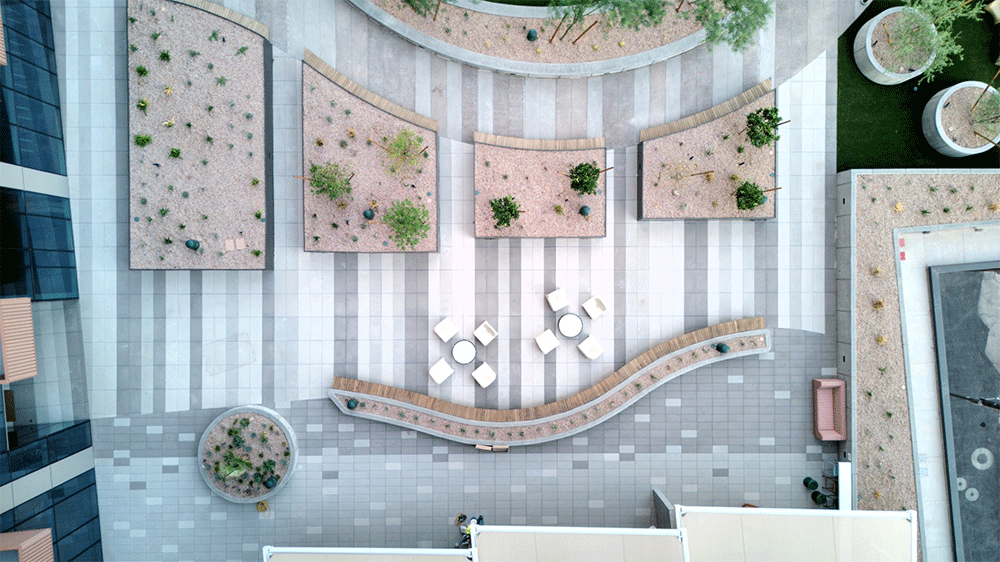
The design played with geometry and perspective, as rectilinear lines flowed parallel in some spaces, then shifted to run perpendicular in others, guiding the eye and defining distinct zones.
The smaller 12″x24″x2″ pavers were arranged in a soft gradient pattern, creating subtle movement and visual depth, while the larger 18″x36″x3″ pavers formed bold, solid bands of color that anchored the design. Carefully chosen shades of grey transformed the vast expanse into a series of engaging environments, from wide-open gathering spaces to quiet, intimate corners.
“It was a gradient pattern. There were three shades of gray. And if you didn’t have them next to each other, you couldn’t really tell which gray it was, but once they were next to each other, you could tell,” Mann said.
Where pavers met curved planters and benches, the team had to execute flawless precision cuts in those heavy slabs, shaping each curve with the patience and skill of artisans.
The design also incorporated pedestal pavers.
“The pedestal pavers are probably one of the most difficult types of pavement to install,” Mann said, “because there’s a lot of different challenges and things to overcome.”
What makes a pedestal paver installation particularly complex is that most of the real work happens below the surface. The pedestals themselves, the fiber grates, the shims, the drainage considerations—these are the elements that determine whether a project succeeds or fails, and none of them are visible in the finished product.
Starting points matter immensely in this type of work. The team had to plan not just where to begin, but where they would end, calculating how cuts would affect stability on pedestals and whether insulation adjustments would be needed. A cut that’s too small might not sit securely on a pedestal system. A poorly planned layout could create problems that only reveal themselves when you’re already committed to a direction.
‘It’s Going to Be Worth It’
“My mantra to myself is that it’s going to be worth it,” Mann said. “All this we’re going through to get to the end product, it’s going to be worth it.”
And it was.
The final North Central project was recognized locally by the Southwest Hardscape Association and earned national recognition by winning the Segmental Concrete Pavement – Commercial (more than 15,000 sf) category at 2025 HNA Awards.
“The owner, project owner and the general contractor were very happy with the finished product, as they should be,” Mann said.
“The team at European Pavers has been doing this for years. We came through with innovative ideas and teamwork and we made it successful on every level.”
Lessons for Aspiring Hardscapers
For those entering the industry or considering hardscaping as a career, Mann emphasizes the critical importance of education from trusted sources. Pedestal paver systems, rooftop applications, permeable installations, these specialized areas require knowledge that goes beyond basic installation techniques.
He recommends pursuing formal education through organizations like the Concrete Masonry & Hardscapes Association. The key, Mann stresses, is ensuring you’re learning from qualified sources with proper backing and vetted information.
“Get your education and get hands on. But make sure you get it from the right source,” he said.
Mann also offers advice on the power of teamwork and taking challenges one step at a time.
“We take it day by day,” Mann said. “We face the challenge. We conquer that challenge and we try to look ahead and see what other challenges are going to be ahead of us and we try to circumvent those when we can.”
The hardscaping industry offers diverse opportunities, from residential patios to commercial plazas to complex installations like North Central.
Each type of project demands different skills and knowledge. What remains constant is the need for proper training, commitment to quality, and the resilience to work through challenges that seem insurmountable in the moment.