It’s powerful to inherit a legacy. Not just a family-owned company, but a philosophy, a way of doing things that was built from nothing, often at great personal sacrifice.
In the hardscape industry, that legacy and inheritance is playing out across family businesses up and down the supply chain, from manufacturers to commercial installers. And the next generation is finding ways to honoring the past while building the future.
Born Into It
For second- and third-generation hardscaping professionals, hardscaping is something they are born into. The smell of a concrete plant. The geometry of a paver yard. Weekends spent doing whatever needed doing, whether that meant sweeping floors, sorting product, or just staying out of the way. By the time they were old enough to make a real decision about their careers, the industry had already seeped into their bones.
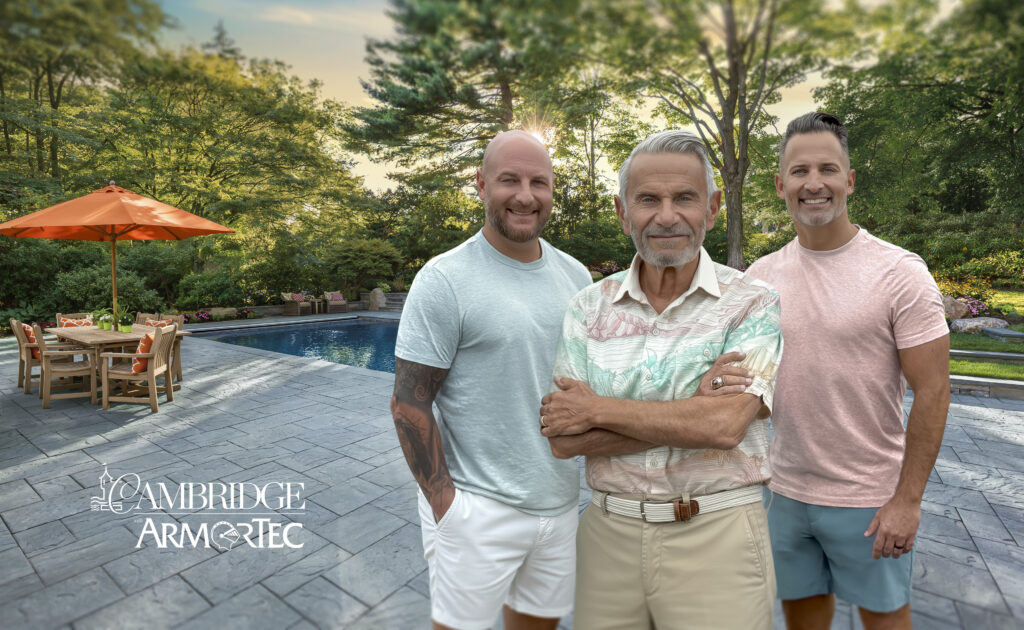
Charles Jr. and Christopher Gamarekian’s father, Charles Sr., founded Cambridge Pavingstones in 1994, when they were 11 years old. Now Charles Jr. and Christopher are both Vice Presidents at Cambridge.
“We were the first employees that worked for free,” Christopher recalled with a laugh.
Saturdays as kids and teens meant walking eighteen acres of property, picking up garbage, sweeping plant floors, repacking cubes, and sorting broken pieces.
“He started us at the bottom,” Charles said. “From the beginning.”
Christopher remembers the moment quality control became his responsibility. His father asked him to inspect every product before it left the facility.
“Seeing that as a 12- and 13-year-old, and looking at each piece before it went out to our customers, and being responsible for that,” that was when the industry really started to mean something to him.
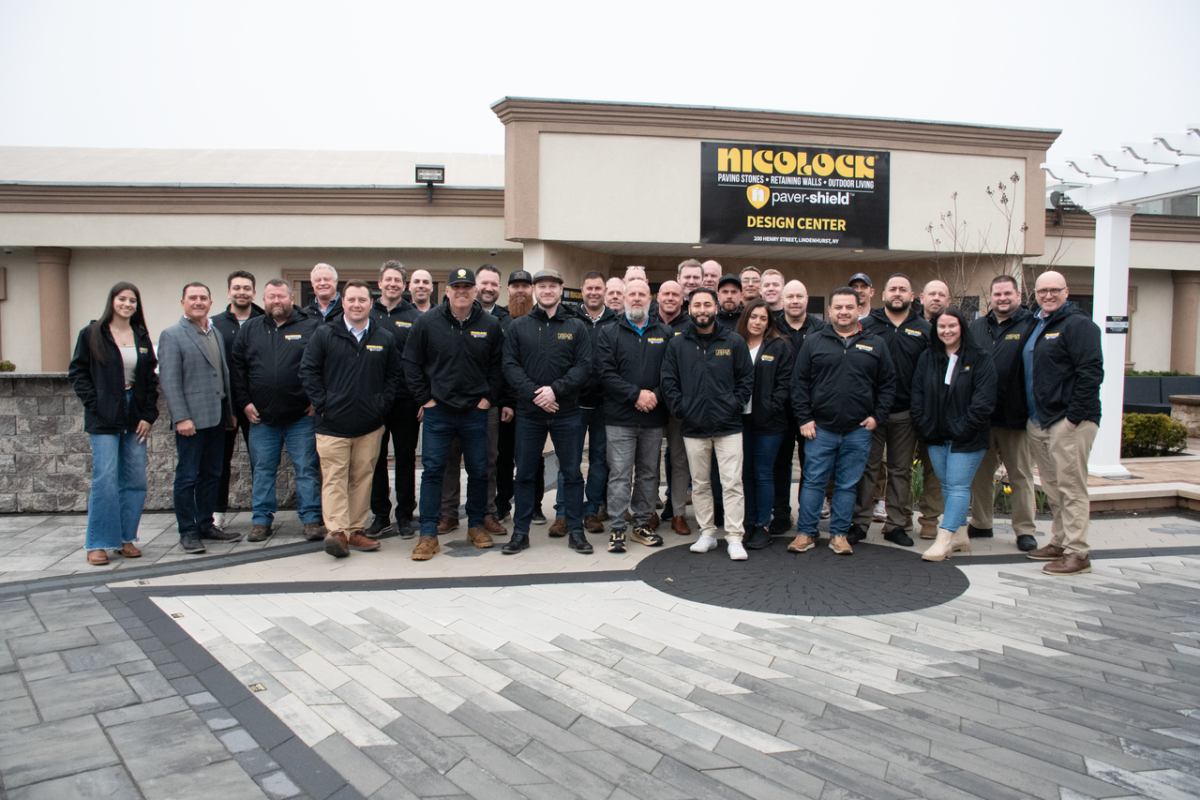
Nino Nicolia, who runs day-to-day operations at Nicolock Paving Stones, jokes that he’s technically “Generation 2.5.” He’s a third generation in the family business, but it was his father, Roberto Nicolia, who started the family’s foray into hardscaping.
Nino’s grandfather, Sante Nicolia, came to America in 1954, at age 19. He worked hard as a laborer and driver for a concrete foundation contractor, saving his money to open his own business. At age 26, he started Nicolia Ready Mix, and brought his wife and their two children to America. They went on to have five more children and currently have 26 grandchildren. Members of these generations of Nicolias now lead and guide the range of companies under Nicolia Concrete Products Inc., including Nicolock.
Nino and his brothers have held every position from sweeping the plant floors to working in the yards to creating new products. They know every aspect of this business; it is part of their DNA.
Choosing the Business
Perhaps counterintuitively, the first-generation hardscaping professionals actively encouraged their children to explore and learn from other businesses.
Charles Sr. was explicit about it: “You cannot work here in college. You guys got to go try other things, get other jobs, to make sure that if one day you do want to come back, you put your hands in other stuff, so this decision was a full force if you wanted to come in.”
Christopher went to Northeastern University, majored in finance, and completed co-ops at John Hancock and Manulife. He was good at it and genuinely enjoyed it. But for his final co-op, he chose Cambridge and spent the last month and a half of his education sitting at his father’s conference table, watching and learning.
“In any given day, he could be talking about a TV commercial we’re going to shoot at 7 a.m., and at 8 a.m. he’d be dealing with the top customer. At 10 a.m., he’d be sitting in an inventory purchasing meeting, and then at 1 p.m., he could be buying a new machine,” Christopher said.
That’s when he knew this was the future path for him.
Charles Jr., meanwhile, always knew he wanted to work at Cambridge.
“I knew I wanted to be at Cambridge. I had no other want. I didn’t even want to go to college,” he said. With his father’s encouragement, he did go to Seton Hall University, graduated on a Friday, and was working full-time at Cambridge the following Monday.
For Derek Schneider, incoming president of LPS Pavement Company, the path back was less linear. He spent years working multiple jobs in Michigan, eventually needing more stability for his growing family. His father offered him a job. He moved back to Illinois, joined the company, and has been there ever since.
“Outside of the life it’s given me, both as a child, and that it’s given to my family, and now to my grandkids, I’m carrying on my dad’s legacy,” he said. “He put so much into this and its big shoes that I’m never going to be able to fill.”
Nino earned a degree in finance and economics and explored those industries before coming back to Nicolock. But he has never looked back, a mentality he said he saw his father model.
“All or nothing. Don’t dip your toe. If you’re going to do something, just do it,” Nino described.
That willingness to go all in, rather than hedging or testing the waters with half-measures, shaped how Nino thinks about his own decisions as a leader.
A next-generation leader who has genuinely chosen the business for themselves is worth far more than one who defaulted into it.
Dividing and Conquering
One of the structural challenges of any family business is figuring out how roles get assigned without it feeling arbitrary or political.
Nino runs the day-to-day at Nicolock while working alongside two brothers and navigating a broader family structure that includes his father’s brothers as partners and cousins spread across different business units.
“There’s a personal level that makes things sometimes easier to get done, and that can also sometimes make it more of a challenge,” he said.
The key, he said, is understanding each other’s strengths and weaknesses and building around them rather than pretending the dynamics aren’t there.
Charles Jr. and Christopher follow a similar philosophy at Cambridge.
Charles Jr. oversees all manufacturing, such as product design, plant operations, QC, new molds, acquisitions, and new facility builds. Christopher handles everything outside the plants, like operations, yard personnel, trucking, sales, and finance. Major decisions belong to all of them together.
What makes the arrangement particularly effective is that it has eliminated siloes.
“A lot of companies, a huge issue is there’s usually a lot of tension between sales and manufacturing,” Charles Jr. said.
Because he and Christopher manage those two sides of the business and, as twins, can be direct with each other in ways that colleagues rarely can, that tension doesn’t get a chance to calcify. Their teams have followed their lead.
Learning from the Previous Generation
Each new chapter of a family-run business begins with the lessons left by the generation before.
For the Gamarekian brothers, one of the most important lessons from their father was about the relationship between how you treat people and how far a company can go.
“Put the customer first, because if you’re doing things right for the customer, then everybody else will flourish,” Charles Sr. has always said.
But the flip side of that, taking care of the people who take care of the customers, has been equally foundational. Cambridge’s average employee has been with the company for 18 years. Some have been there since the first day, 32 years ago. That didn’t happen by accident.
Christopher describes mutual respect as a non-negotiable.
“Whether it’s someone who is sweeping the floor here, or someone in an office, everyone’s treated the same,” he said. “If someone does not treat someone that way, they will not last here.”
That value came directly from watching their father live it, not from being told about it.
Schneider’s education from his father was similarly rooted in how you treat the people around you. Schneider said his father occasionally co-signed on employees’ mortgages and covered dental work for people who couldn’t afford it themselves. He put the company and his employees first, even when it cost him personally.
“You’re only as good as the people that work for you and how you teach them and how you bring them up,” Schneider said. “You really need to grow that culture of pride in what you do with all your employees, at every level. It makes the company better, and as long as the company’s doing well, everybody should be doing well.”
The reciprocal nature of that relationship is something he’s worked to replicate in his own leadership.
Nicolock also wants every employee to feel like family. Nino’s father would walk the plants and yards every morning to check the products and quality being produced and to say hello to all the employees. Now, Nino does it every day just like his dad.
That personal touch also applies to clients.
“One of the benefits of a family business is you can meet with somebody, look at them, shake their hand, look them in the eye, and tell them, this is what we’re going to do,” Nino said.
Nino recalls that one time Roberto sent him to Pittsburgh to speak with a dealer. He asked why he had to drive nearly seven hours when he could have a 10-minute phone call. Roberto said it had to be done in person. It couldn’t be done via email, text, or phone because some parts of doing business do not translate through a screen or a call. It’s not about efficiency, it’s about effectiveness. Going there in person shows commitment and that you value their partnership.
Balancing Tradition and Innovation
Beyond the lessons and values they’ve taken from previous generations, second- and third-generation hardscaping professionals often have to balance respect for “how it’s always been done” with the need to modernize.
“The best part about this company [Cambridge] is my father hates to hear people say ‘that’s how it’s always been done,’” Christopher said.
That philosophy shows up in small, operational ways — the team once cut customer loading times from over an hour down to 25 minutes simply by asking how to do it better — and in larger strategic ones, like Cambridge’s decades-long commitment to face-mix production at a time when the rest of the industry considered it unnecessary.
“We completely changed this industry,” Charles Jr. said, “and now everyone is doing face-mix.”
For Nino and Nicolock, the balance between inherited knowledge and modernization is more nuanced.
“Their knowledge comes from experience,” he said. “That core knowledge has existed and stuck around for a reason.”
The skill, as he sees it, is being able to “finesse it into today’s world,” understanding where tradition applies and where the market, the technology, or the customer base has shifted enough to demand something different.
If the demand is there, Nino describes, the Nicolia family will build it themselves. Once they needed special packaging for a high-end outdoor living item and couldn’t find something that worked, so they built a mold, engineered a tool to fill it, and laser cut it to create something custom that fit and protected the item perfectly. They always aim to make sure their customers are satisfied from the best materials to the best experience.
Schneider sees the hardscaping industry’s future tied to this question of balance between modernization and tradition.
LPS’s history is a case study in that kind of ongoing reinvention. The company was the first to do mechanical installation of pavers, the first to do mechanical installation of permeable pavers, the first to do permeable paving at commercial scale. Schneider watched Nashville go from having no permeable paver market to being arguably the largest market for them in North America.
“We’ve got a lot of firsts here,” he said.
Innovation, in his experience, happens because someone decided to try something that hadn’t been tried before, and then did it right.
Legacies Built to Last
These family businesses are still defining their legacies, balancing the preservation of hard-earned values and craftsmanship with carrying the company forward.
Christopher and Charles each have four kids. Christopher’s oldest has started coming in on Saturdays, working the way his father once did.
“Maybe one day he’ll want to do it. Maybe he won’t,” Christopher said. He won’t push it. What he wants for his kids, first and foremost, is that they find work they’re genuinely passionate about, the same way he did.
Nino’s children are younger, but the lessons he’s already thinking about passing down have less to do with the business than with the character required to succeed in it.
“As the owner’s son, you have to work more and work harder than other people just to get the same recognition,” Nino said.
He figures that lesson and spirit will serve them whether they end up at Nicolock or somewhere else entirely.
Schneider’s sons have already made an impact on the family business and taking their place in its generational legacy. His oldest son worked for him for five years before moving into the mechanical design field. His youngest son, the namesake of Schneider’s father and LPS founder Bill Schneider, has started a career with LPS with an eye toward running the company in the future.
Schneider also sees his family’s legacy showcased in their hardscaping installations around the country. The residential neighborhood his father’s company paved in 1979, one of their first big projects, is still fully functional today.
“If it was concrete or asphalt, by now it would have been replaced five, 10 times,” he said.
That durability might be the best metaphor for these family-owned hardscaping businesses. They are built to last for generations to come.