Tag: Working in Hardscaping

Ultimate Backyard Lancaster: A ‘Once-in-a-Career’ Hardscaping Project

Jeremy Martin, owner of Willow Gates Home & Landscape, first received a call from his client about the “Ultimate Backyard Lancaster” project in summer of 2023. Martin was on vacation at the time, but he was so intrigued by his client’s description of their dream project that he felt compelled to respond immediately.

“It was the kind of project that comes along maybe every 10 years, maybe once in a career,” Martin said.

Ultimate Backyard Lancaster would eventually go on to win the Segmental Concrete Pavement – Permeable category and earn an Honorable Mention in Outdoor Living Features category at the 2025 Hardscape North America Awards.

But the Ultimate Backyard Lancaster isn’t just an award-winning project. It’s proof that even the most ambitious visions can become reality when every detail is treated with care.

Building a Dream

Martin’s client had been planning this project since 2015, when he first built his home. By the time he reached out to Martin, the architectural drawings for the entertainment barn the project included were mostly complete, but the real work was just beginning.

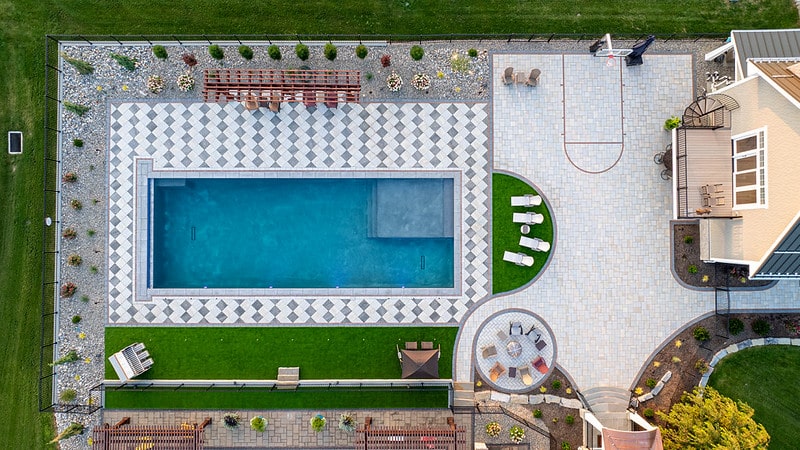
Martin thinks and designs in 2-D. For this project, he started with the two largest features: the barn footprint and the pool dimensions. From there, he built outward, carefully considering how each element would flow together.

In addition to the barn and pool, the client also initially requested a full half-court basketball court. Once Martin showed him what that would require, they scaled back to free throw lines and other basketball court elements so the final look would still be impressive, but not overwhelming.

Finding the Right Materials

“One of the guiding principles was this had to look like it’s built at the same time as the home, despite being 10 years later,” Martin said.

That guiding principle would shape every design decision for Martin.

The property also already featured outdoor living space built in 2017, complete with a bocce court and outdoor kitchen. Rather than forcing a perfect match with the older materials, Martin took a thoughtful approach.

All retaining walls and the barn used a natural stone veneer that matched the outdoor kitchen and closely coordinated with the house. This created cohesion instead of contrast.

“I really hated the idea of adding in yet another color, another texture,” Martin said. “I didn’t want it to be a complete fruit salad of everything thrown in there.”

For the pool patio, the client fell in love with the texture of Techo-Bloc’s Everest paver and wanted it in a diamond pattern using three colors: very dark gray, light gray, and medium tan.

When the client initially requested mixing all three colors in three different sizes throughout the large patio in addition to the pool, Martin pushed back.

“I said, ‘That’s just way too busy. We need to dial it back,’” Martin said.

Instead, Martin used the same color palette in much more muted tones—very light gray, very light cream, and very light tan—for the main patio. The result was visual interest without overwhelming the massive space.

“I love it. I think that really brought it all together. Those colors came together perfectly,” Martin said.

Sweating the Details

The curves in this project stand out as the most challenging and rewarding elements for Martin.

Martin wanted the semicircle at the shallow end of the pool, a curved walkway, and a circular fire pit seating area to flow together perfectly. He spent hours during the design phase ensuring these curves aligned, then duplicated that precision in the field.

“Those are the little details that I really sweated,” he said. “They were really important to me, and you’re like, ‘is it really worth it?’ You look at a picture at the end, and, yes, it was worth it. Those curves all are pretty much perfect.”

The same attention to detail extended to the diamond pattern around the pool. Martin designed the borders and everything to work with full and half diamonds—no slivers anywhere. All four sides were laid out meticulously to avoid any partial cuts.

The Permeable Challenge

Adding nearly a quarter acre of impervious surface in Pennsylvania’s Chesapeake Bay watershed meant serious stormwater management requirements. The project needed a 100-year stormwater plan capable of storing 7.5 inches of rainfall.

The solution required making the entire patio and all artificial turf areas permeable with a 20-inch base.

“It’s kind of crazy. We didn’t need that much base, it’s simply a patio, but we had to store 7.5 inches, and that’s what it came out to be,” Martin said.

The team also constructed a massive infiltration bed measuring 30 feet wide by 90 feet long and 30 inches deep for the barn, driveway, and other improvements.

“Permeable truly does make sense. It’s good stewardship. It’s good management, and given you’re building a patio anyway, we’re already putting a base in. To make it deeper and put stormwater management underneath it just makes sense in a lot of cases,” Martin said.

A Year in the Making

From initial contact with the client to getting permits in hand took a full year. Stormwater planning alone consumed over half that time.

Installation continued right up until winter arrived, with the team working as snow was flying and temperatures dropped into the teens.

But the most rewarding moment came during installation. Martin arrived one Saturday to find his client playing basketball with his granddaughter on the not-quite-finished court.

“This really kind of encapsulated why he wanted to build this. It’s for his family and his friends. It’s not a public space, he’s not renting it out, this is just a place for him to hang out with his friends and family,” Martin said.

“It’s easy to lose sight of that when you’re building something this over the top, but at the end of the day, that’s what it’s for. He’s hosting people there constantly, family, friends, board meetings. He built this place to be used. It’s not just something to show off with. This is a place he wanted to use, and he is. He’s using it all the time.”

Details Over Scale

The scale of this project is staggering. More than 4,500 square feet of pavers isn’t something you see often.

“Everyone who’s seen this project is kind of mind-boggled by the sheer scope,” Martin said. “I do view it as very much a privilege and an honor to be able to build this for the client.”

Winning in two categories at the 2025 HNA awards validated all the hard work Martin and his team put into the project. For aspiring hardscapers who want to one day work on their own award-winning projects, Martin encourages them to focus on the details, not just the scale.

“Details matter,” Martin said. “Just the sheer scope of a project or sheer scale isn’t really the most important thing. So yes, this is an amazing project, a once-in-a-lifetime project that I never even would have dreamed of. But it’s really the little details that matter, whether it’s a big project or a small project.”

He points to the clean diamond pattern around the pool, the perfectly flowing curves, the muted and coordinating color palettes. These are the elements that elevate good work to exceptional work.

“If you lay a 5,000-square-foot patio and there’s no character to it, the joint lines aren’t straight—you missed the point, you know?” Martin said. “I don’t want to do that kind of work. To me, it’s not the sheer size. I care about the details.”

His client’s decade-long dream is now a showcase of what’s possible when scale meets meticulous hardscaping craftsmanship.

AI in Hardscaping: Blending Innovation with Education

As AI tools become increasingly accessible, hardscapers look to harness these powerful new tools without sacrificing the foundational knowledge that separates professionals from hobbyists.

AI as a Workflow Enhancer

For many in the industry, AI has already moved from experimental to essential.

Weston Zimmerman, founder of SynkedUp, calls AI “an accelerant to the things that you need to do already anyway.”

For instance, contractors writing proposals at 10 PM, exhausted from a long day, can now “give AI your rough and polish proposal description, let it clean it up for you, tweak a little bit and use that,” Zimmerman said.

“They’re using AI to help them come across as more polished, more well presented in their written communications with their customers.”

Eric Hammer, Partner at WestBlock Systems, echoes this workflow enhancement approach.

“I use AI on the daily,” Hammer said, “because it actually really helps me be more efficient in my workflow or in providing clarity in documents that I’m writing.”

As the founder of SynkedUP, a business management software company focused on the hardscaping and landscaping industry, Zimmerman believes the impacts of AI will go beyond convenience. 

“Documentation of processes is the very thing that keeps owner-operators prisoner in their own businesses. Until that happens, you are forever the only person that can do whatever task,” Zimmerman said. “With AI that is so much easier because you can literally shoot a video of you doing XYZ task, whether it’s out in the field or in the office or whatever, and feed that video to AI and it’ll shoot out a nice document with a list of steps that you need to take to do the task and do it well.”

Zimmerman also notes that most hardscaping businesses are sitting on “data goldmines.”

“A lot of operators are failing to document their own data,” he said. “They estimate a job—it’s going to take 250 hours and X dollars’ worth of materials to go out and do it—but they never document how many hours it actually took them. Every job that gets finished without tracking the resources and the hours and materials that went into it is a lost opportunity to build your own archive of data.”

Even without AI, this data helps you avoid repeating mistakes. But as AI becomes more integrated into industry tools, that data will help you get more accurate results for business processes and estimating.

“Take the time and track your hours and resources per work area in a job. Even if you’re not feeding that to AI yet, that data will become super valuable as AI becomes more prevalent, since you will have way more history to feed into your AI tool,” Zimmerman said.

“…My hope is that some of these problems that exist in the industry, with AI, the bar will be lowered on how easy it is to solve them.”

AI for Visualization and Manufacturing

There are additional applications of AI that show particular promise.

Hammer describes a workflow that’s already transforming his client presentations.

“I will draw out a full layout in SketchUp, then I’ll take a screenshot of that, and I’ll upload it into ChatGPT and say, ‘Make this look photoreal,’” Hammer said. “Conveying the final vision or the possibilities that can be done is huge.”

Looking ahead, Hammer believes that manufacturing could be revolutionized by the combination of AI with Internet of Things (IoT), a network of physical devices, vehicles, appliances, and other physical objects that are embedded with sensors, software, and network connectivity, allowing them to collect and share data.

“I think that that’s going to be a huge thing where maybe you don’t actually need a full-time machine operator,” Hammer said.

But Hammer is quick to point out AI’s current limitations. When he tried using AI to solve a specific engineering problem, “it just was not able to comprehend, so there’s still that human aspect to it.”

This distinction matters. AI excels at augmenting human expertise, not replacing it. The professionals who will thrive aren’t those who hand everything over to AI, but those who understand where AI adds value and where human judgment remains irreplaceable.

Why Education Matters More Than Ever

AI’s power and potential can create significant risks, especially in an industry where engineering precision can be the difference between a structure that lasts decades and one that fails.

“While it’s very cool, it’s also very dangerous in some ways,” Hammer said. “You have to put in very strong restrictions on what it’s able to provide, and what its source of truth is.”

Richard Ansley, Professor and Landscape Design & Management Program Coordinator at Columbus State Community College, frames the challenge even more directly. As AI becomes integrated with Building Information Modeling (BIM) and design software, “AI is going to walk you through it so much faster. And if it doesn’t know on their website, it will reach out to another server that’ll bring it to you.”

But speed without discernment creates problems.

“Students or new professionals can watch a video on Facebook and think that’s the way we do it,” Ansley said. “We don’t want students thinking that everything they see on the Internet is gospel.”  

The same applies to AI-generated information.

“AI will give us everything we want. But do we want all of it?” Ansley said. “What do you want from it that you can be a professional about?”

What Aspiring Hardscapers Should Know

For aspiring hardscapers, the willingness to explore AI and new technologies can be a competitive advantage, but only when paired with solid fundamentals.

If you’re looking to enter the hardscaping industry in the age of AI, here’s what you should consider:

  • Develop prompt engineering skills. Being able to write effective AI prompts requires deep understanding of what you’re trying to achieve. You need to know enough to ask the right questions.
  • Pursue formal education. Whether it’s a college degree, trade school, or CMHA certification, structured learning gives you the foundational knowledge to use AI critically rather than blindly.
  • Learn to verify, not just trust. Can you tell when AI gives you information that’s technically unsound?
  • Develop data discipline. Start tracking time and resources by work area from your first job and look for other areas where you can collect information and data that might one day inform useful AI outputs.
  • Embrace the innovation mindset. Those willing to thoughtfully integrate new tools while respecting proven principles will stand out.
  • Understand the limits. AI should be a tool, not a substitute for expertise.

AI in hardscaping isn’t about replacing human expertise; it’s about amplifying it.

The professionals who will thrive are those who build strong foundations first, then leverage AI to work smarter, visualize better, and stay ahead of competition still stuck in old patterns.

The 5 Cs: Hardscaping Skills You Can Hone Before You Get Started

If you’re thinking about breaking into the hardscaping industry, you might be wondering if you have what it takes to succeed.

The good news is that many of the most critical skills aren’t about knowing how to lay pavers, they’re transferable skills you may already possess or can develop right now.

Let’s call them “the 5 Cs.”

1. Curiosity

Andrew Letersky, Founder of Ultimate Landscape Academy, was the kid with endless questions, taking apart household items, tagging along on handiwork, and always building contraptions. His insatiable curiosity became one of his greatest business assets.

“If you have that curiosity, that burning desire to figure things out,” Letersky said. “That really leads you into an investigation mode.”

When you’re curious, you naturally ask the important questions when things don’t work the way you planned. How can I make this better? How can I tweak this? How can I make the customer experience better? How can I get more leads? How can I do this faster? How can I be more efficient?

“If you tell your potential employer, ‘Listen, I’m teachable, and I will learn fast. I just need someone to show it to me and answer my questions,’ every employer wants to hear that,” said Frank Bourque, Landscape and Hardscape Business Consultant.

This mindset of constant questioning and refinement is what drives career and business growth.

2. Character

“If I had one piece of advice to any human on the planet who wanted to become a stronger, a more dedicated, a more present, a more successful version of themselves, it would be simply: do what you say you’re going to do when you say you’re going to do it,” Letersky said.

It sounds basic, but think about how rarely people actually follow through, especially on promises they make to themselves.

“It’s easy to keep promises to other people, but it’s super hard to do it for yourself because typically the repercussions are not as present,” Letersky said.

When we break promises to ourselves, something deeper happens.

“You lose self-trust, and the self-trust translates into self-love, and self-love is what you need for true confidence,” Letersky said. “Because if we aren’t confident, then sales are difficult. Communication is difficult. Showing up is difficult.”

3. Consistency

Consistency is closely tied to character. It’s an active choice to keep showing up and to showcase what is a priority to you.

“When we try something new, we’re going to go through that uncomfortable phase. It’s the people that try something and push through that difficult phase and get to the other side of it that are the ones that really succeed,” said Vanessa McQuade, VP of Sales & Marketing and Co-Owner of Intrigue Media. “Look at yourself as a person that’s adding value. Lead with confidence.”

Letersky frames it as “discipline,” the ability to do the work day after day, even when motivation fades.

“If it was easy, every single person would be doing it. Starting’s the easy part, but the hard part is what separates people,” Letersky said. “The hard part is what leads to the freedom. It’s what leads to the financial rewards, the success on the other side.”

An employee who shows up consistently, communicates absences well in advance, and can be counted on becomes invaluable, whether you are working directly on a hardscaping crew or in the office.

“If you want your value to go up, focus on reliability,” Bourque said.

4. Communication

Strong communication skills impact every aspect of your career and business.

“If you’re not able to communicate the services you offer, or the way that you can help them, or the emotional benefits to them—the certainty that they get or the removal of fear or things like that—if you can’t communicate those things with a customer, then your sales process takes a big hit,” Letersky said.

“Communication is as much about being able to speak as it is to be able to listen…It’s not about the answers you give, but it’s about the quality of the questions that you ask that you’re judged on. Instead of giving them what’s important to you, being able to ask a simple question of, ‘Before I tell you about our company, what is it that you’re looking for from a landscaper?’ That shift changes the whole conversation because then they’ll tell you what’s important for them and you can relay now why you’re the best choice based on the things that they said were important.”

The same advice goes for a job interview in hardscaping.

“I think you should be asking more questions than talking about yourself—about the company, about the process, about the company culture, about the management,” said David Huber, National Hardscape Sales Manager for Alpha Professional Tools.

5. Commitment (to Self-Reflection)

The final C might be the most transformative: the commitment to honestly evaluate yourself.

“The ability to self-reflect—if you’re the kind of person who can look themselves in the mirror and say, ‘Hey, listen, let’s think about the last day, week, month. What did we say we were going to do and then we didn’t do it? Where do we need to focus some more time and energy over the next month?’” Letersky said.

“Being able to self-reflect on your own performance to see where the gaps are in your own skill sets or your own mindset or your own habits, that sets you in the top 1 percent or even .1 percent of the people in the industry.”

Getting Started

You don’t have to wait until you have mastered “the 5 Cs” to get started. Work toward developing these foundational traits and trust that the technical skills will grow alongside them.

“I was probably the most inadequate individual when it came to starting my business,” Letersky said.  “I had no business experience. I had no idea how to get customers. I had no idea how to win. I did one patio in my entire life prior to starting my landscape business. Through my inquisitive nature and curiosity and the desire to not quit and go work somewhere else, I pushed ahead.”

If you’re unsure whether you belong in hardscaping, start by honestly assessing these qualities in yourself. Which ones do you already have? Which ones need work? The beauty of these skills and traits is that they’re all improvable and you can start today.

“You don’t have to be the smartest. You don’t have to be the quickest. You don’t have to be the best at getting the stuff that you need,” Letersky said. “You just have to have that vision and that belief that you’re going to get what you want and you’re going to go after it no matter what happens.”

Entrepreneur vs. Employee: Which Path is Right for Aspiring Hardscapers?

Every hardscaper faces a big decision at the start of their career: should you begin by building your own business or gain experience by first working for someone else?

Both routes have their pros and cons. Running your own company means independence, but also risk; working as an employee offers stability and mentorship, but less freedom.

If you’re an aspiring hardscaper wondering where to begin, advice from a few industry professionals can help you find the path that fits your personality, goals, and lifestyle.

Learning Then Leading

Dan Hughes, President of Segmental Systems Inc., spent nine years working for a landscape company before eventually purchasing an established hardscape business. That time as an employee was an education.

“I constantly observed how things were done, good and bad, and compared it all to other companies in the area,” Hughes said. “I learned all the basics of landscaping, sprinklers, different construction methods, and even some landscape maintenance.”

More importantly, he gained crucial management experience.

“The longer I was there, the more experience I got running/managing crews, dealing with customers, knowing what we needed for supplies for the day, planning for the next several days, equipment repair and usage,” he said.

However, Hughes is candid about what he didn’t learn as an employee.

“What I never learned was sales, estimating, overhead, payroll, taxes, and the business end of it all,” he said.

When Hughes started working for Segmental Systems with the intent to purchase it, the owner made it his mission to teach him as much as he could during the transition.

Looking back, Hughes appreciates the foundation his employment years provided, but he also acknowledges the value of buying into an established operation.

“You avoid the struggles of having to do all the work yourself while still trying to find work and build a business. That’s a tall hurdle and I applaud those who have done it successfully. It’s a grind to get there for sure. But buying something existing, partnering up with an established business allows you to focus on building and making things better rather on fighting to survive,” Hughes said.

“…If I were to do it all over again, I would definitely work in the trade for a quality contractor and look to buy in or out that company. Starting from scratch is quite risky, and extremely volatile in the dips in the economy.”

Finding the Right Employer

Weston Zimmerman, founder of SynkedUP, experienced a transformative shift in how he viewed employment, one that ultimately prepared him for entrepreneurship.

Starting as a teenager at Tussey Landscaping installing water features and koi ponds, Zimmerman admits he was initially “your average employee” who “worked hard when I was there, but I wanted the Fridays off and I wanted to go do this, I want to go do that.”

Everything changed after he got married and his priorities shifted. At an Aquascape convention in Chicago, hungry to make more money, he approached CEO Greg Wittstock about job opportunities.

“He looked at me like I had three heads,” Zimmerman said. “And I said, ‘Well, I just want to make more money,’ and you can see that he had heard this 100 times. He said, ‘Go back and talk to your boss and ask him what can you do to make the company more money, so that you can make more money.’”

Zimmerman never looked at employment the same way again.

“My mindset, my perspective as an employee shifted forever from that moment on,” he said.

That shift led Zimmerman to become not just a crew lead, but also Director of Marketing at Tussey, launching their social media presence, YouTube content, filming and editing, and managing their website.

Both Zimmerman emphasizes that not all employment experiences are created equal.

“There’s a key ingredient that has to exist and that is the owner of that company has to be willing to give you the autonomy. I could’ve had the exact same story at Tussey Landscaping, but with a different owner that wasn’t willing to give me the rope to climb and it would’ve failed for both of us,” Zimmerman said.

Instead, Zimmerman was able to really have a seat at the table at Tussey and started to offer ideas for business processes and process optimization. That experience eventually led him to founding SynkedUP, a software company that’s transforming how hardscaping businesses operate.

“I actually would probably encourage going and working for someone for a while, but I would also say in the same way that the employer is interviewing you, in your own mind be interviewing the employer,” Zimmerman said. “If you’re going to work for someone, be considerate and thoughtful about who you’re choosing to work for because that’s a key part of the equation in making that successful.”

Built for Independence

Outside of three years in the military, Gary Stowe, President of Stowe Contracting, Inc., has worked for himself since he was 13. For him, entrepreneurship isn’t just a preference, it’s a necessity.

“I’m not a good employee,” Stowe said. “That’s kind of what people need to understand if they want to go in business. It can’t be, ‘I’d like to go in business.’ It’s, ‘I have to go in business.’”

Stowe’s career path in hardscaping has been unconventional. With a nursing degree and three years in the Army, he spent a decade running an auto repair shop before transitioning to construction in the late 1980s. But while these fields seem widely varied, Stowe said they all really come down to his passion for fixing things.

Each career shift also taught him something valuable about business operations, pricing, and customer relationships, lessons that helped him build a successful hardscaping company.

One pivotal lesson came during his struggling years in the auto repair business. Working 70-hour weeks, he accompanied his wife to their accountant for tax preparation. The accountant looked at their returns and said, “You know, you can apply for food stamps if you want.”

“That was kind of an epiphany for me,” Stowe said. The turning point came when he realized he needed to bid jobs properly and account for real overhead costs. “You can’t look at the job—the parts, the pieces of the job, the labor it takes to do the job—that’s only one small part of it. You’ve got overhead of just being in business, and you have to recognize that.”

For Stowe, the appeal of entrepreneurship is clear.

“The ability to make your own decisions, the flexibility to do that. The ability to turn down customers if it becomes necessary, to pick and choose who your customers are, the type of work you want to do,” he said.

He acknowledges the demands are real and that it is not a traditional 9-5 job. He keeps a notepad by his bed because he wakes up thinking about work and he stresses the constant planning and organization required to run a company. But despite the challenges, he’s found deep satisfaction in his path.

“It’s a very fulfilling lifestyle. It’s a great way to employ yourself and others,” he said. “It gives you a great deal of satisfaction, and it’s well worth all the heartache that you go through.”

The Employee’s Path

Elias Null, Optimas Specialist at Pave Tool, pushes back against the cultural assumption that entrepreneurship is the only path to success or fulfillment.

“Society pushes to have your own business and be your own boss. And that’s great! That really is awesome, but different personalities are different, and you don’t actually need to be your own boss to have a good life,” Null said.

For him, the focus isn’t on titles or ownership, it’s on personal growth.

“The goal for myself would be to be the best version of myself that I can be,” he said. “Life is like a creek, and if you’re just sitting on a creek in a kayak or canoe, you’re going to end up downstream. You have to stay rowing upstream if you’re going to have a better life.”

Null’s perspective is a reminder that career success isn’t one-size-fits-all. For those who thrive in structured environments and prefer to focus on craft over business operations, the employee route can be just as rewarding.

Finding Your Path Forward

Determining the right path for you really depends on honest self-assessment. Consider these questions:

  • Are you willing to learn the business side? As Hughes and Stowe discovered, field skills alone won’t sustain a company. You need to understand estimating, overhead, taxes, and cash flow or be willing to learn.
  • Are you energized or drained by business management tasks? If paperwork, bidding, payroll, and planning excite you—or at least don’t exhaust you—entrepreneurship might fit. If you’d rather focus purely on the craft, employment could be your path.
  • How do you handle uncertainty and financial pressure? Hughes notes that even with an established company, “there were a few times where work was sparse. Very stressful when you have a fairly large monthly payment on a business.” Can you weather those storms?
  • Do you need autonomy to be happy? Stowe’s realization that he couldn’t work for others came from recognizing his personality. Some people thrive with structure and clear expectations; others suffocate under them.
  • Can you find the right mentor? Both Zimmerman and Hughes benefited enormously from employers willing to invest in their growth. If you choose employment, choose carefully.

There’s no single right answer. The hardscaping industry has room for all approaches.

Whether you choose to work for a quality contractor, buy into an existing business, or strike out on your own from day one, success comes down to dedication, continuous learning, and being honest about who you are and what you need to thrive.

The Surprising Skill That Will Set You Apart in Hardscaping: Making a Phone Call!

If you’re looking to break into the hardscaping industry, you might have been focused on learning the technical skills, such as how to lay pavers, build retaining walls, operate equipment, or studying materials or sales techniques.

But there’s one skill that could set you apart from other job candidates and make you incredibly valuable to potential employers from day one – the ability to pick up the phone and actually talk to people.

Why This Skill Makes You Instantly Valuable

According to Vanessa McQuade, a marketing expert who works extensively with landscape and hardscaping professionals, “It seems super basic. But that is a huge thing. People are scared of the phone.”

McQuade has access to extensive call tracking data across the hardscaping industry, and what she’s discovered should get your attention.

“One of the biggest things for landscapers and hardscapers is they’re not picking up their phone,” she said.

Business owners are literally losing money because they can’t or won’t handle incoming calls properly.

Even when many professionals do answer their phones, they can miss crucial opportunities.

“If they do pick it up, just answering with a really nice voice makes all the difference,” McQuade said.

That first interaction sets the tone for everything that follows.

Standing Out in the Hiring Process

As a marketer, when McQuade asks hardscaping professionals what makes them different from their competitors, she’s looking for unique selling points.

One response that doesn’t come up nearly often enough? “We pick up our phone.”

“It honestly, is a huge difference,” she says. “It can be a good way to stand out among the crowd.”

As a job seeker, you can use this same principle.

When you’re interviewing for hardscaping positions, most candidates will talk about their physical abilities, their willingness to work hard, or their basic knowledge of the industry.

But imagine being able to tell a potential employer, “I understand that phone communication is crucial to your business success. I’m comfortable speaking with customers, I can represent your company professionally, and I know that every call could be worth thousands of dollars to your bottom line.”

If you can position yourself as someone who understands these challenges and has the skills to help solve them, you become much more than just another hire.

How to Develop This Skill Now

Particularly for Gen Z job seekers, there has not been as much opportunity to practice making and receiving telephone calls. It’s no longer the main function of phones. While people can do basically anything on their phone, the default is texting or voice notes or online chats.

Before you even have a job in hardscaping, you can work on developing your phone communication skills by doing the following:

  • Practice professional phone etiquette. Encourage friends or family to call you and work on answering calls with enthusiasm and clarity. Your greeting should immediately convey professionalism and helpfulness.
  • Learn to ask good questions. Practice gathering information over the phone. You’ll need this if you need to ask about projects, timelines, and customer needs in your hardscaping role.
  • Understand the business impact. Study how customer communication affects hardscaping business success so you can speak intelligently about it during interviews.
  • Role-play customer scenarios. Practice handling different types of calls – initial inquiries, follow-ups, scheduling, and problem-solving – with friends, family members, or other job seekers.

Your comfort with this skill can be a game-changer. When you walk into an interview, you’re offering to solve a real business problem that’s costing hardscaping companies money every day.

Your technical skills will develop with experience, but your ability to communicate professionally with customers is something you can master right now. It might just be the skill that gets you hired!

Transforming Public Spaces: Inside European Pavers Southwest’s Award-Winning Hardscape at Scottsdale Civic Center Plaza

The Scottsdale Civic Center Plaza, a nine-acre public gathering space in downtown Scottsdale, Arizona, has been a community cornerstone for over 50 years. As part of a $27.5 million bond-funded renovation, the plaza underwent a complete overhaul to modernize its infrastructure and aesthetics while enhancing its year-round usability.

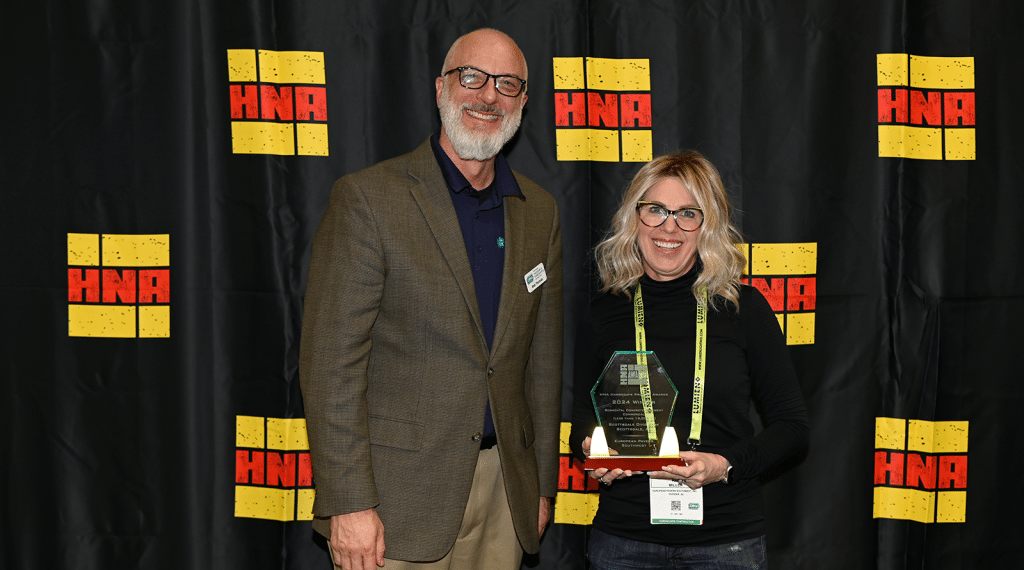
European Pavers Southwest played a crucial role in transforming this urban oasis, earning national recognition for their work. Their efforts were celebrated at the 2024 Hardscape North America (HNA) Awards, where they took home the top prize in the Segmental Concrete Pavement – Commercial (less than 15,000 sf) category. The event recognized outstanding hardscape projects from 215 submissions across 19 categories.

European Pavers has built up a reputation for municipal work, especially in Arizona, and she was thrilled when they were selected to take on this Scottsdale project.

“It was a huge project,” Kimberly Miller, President of European Pavers Southwest, said. “It’s our reputation. We’ve been here for so long in Arizona and throughout the Southwest. People know our workmanship. They know that we return our phone calls. They know we show up for punch lists. They know we’re honest,” Miller said.

Reimagining an Iconic Public Space

Scottsdale Civic Center Plaza consists of nine acres of pristine open public space constructed over 50 years ago in the heart of downtown Scottsdale, Arizona. With a bond-funded $27.5 million budget, the Civic Center Plaza Renovation Project included upgraded utilities, regraded and drained landscapes, and newly installed hardscapes. Key additions include two multi-functional stages, restroom facilities, a children’s play area with a mist-fog system, and expansive pedestrian walkways designed with eye-catching pavers. 

European Pavers Southwest worked on four distinct areas of the revamped plaza. Their award-winning section spans 4,800 square feet and showcases an intricate series of concentric and patterned circles crafted with various types of stones and permeable pavers.

The project took about four weeks to complete. The visually striking design required technical precision, expert craftsmanship, and honest feedback. These are the qualities that have built the company’s impressive reputation throughout Arizona and the Southwest.

Crafting for Community Impact

Miller finds deep satisfaction in contributing to public works that the entire community can enjoy.

“I love those jobs because they’re so high profile,” she said. “It’s something that somebody’s going to see.”

The plaza’s pavers, supplied by Ackerstone, perfectly complemented the design vision crafted by the City of Scottsdale. This collaborative effort highlights how hardscaping goes beyond construction—it’s an art form that can redefine public spaces.

With a complete overhaul, the site’s new layout is designed so that all nine acres of the plaza can be utilized throughout the year. The existing hardscape was removed, and an extensive grading operation lowered the grade by as much as six feet in some areas. Several hills were moved to enhance the view of the park. New decorative hardscape and pedestrian walkways—a combination of concrete and pavers—made this linear civic space more inviting to users and visitors. 

A Surprising Win

With 215 project submissions across 19 categories, the 2024 Hardscape North America (HNA) Awards showcased hardscaping excellence in materials such as concrete pavers, clay bricks, retaining walls, adhered thin veneers, porcelain, natural stone, and vintage installations.

European Pavers Southwest took home the top prize in the Segmental Concrete Pavement – Commercial (less than 15,000 sf) category for its work on the Scottsdale Civic Center Plaza.

Despite their stellar work, the European Pavers team was genuinely surprised when their project was announced as the first-place winner.

Because of the way they saw the boards displayed at HNA, they thought they had gotten fourth place and the photos were just being shown as additional project examples.

“Needless to say, we were all shocked!” European Pavers posted on Facebook with the announcement of their win.

Inspiring the Next Generation of Hardscapers

European Pavers Southwest’s success at the HNA Awards proves that hardscaping is more than laying stones—it’s about shaping environments, telling stories through design, and leaving lasting legacies.

For aspiring hardscapers, projects like Scottsdale Civic Center Plaza show how creativity and craftsmanship can blend into something truly remarkable.

As Miller summed up, “We take pride in what we do. Saying I’m proud of my team is an understatement.”

GET STARTED WITH A CAREER IN HARDSCAPING TODAY!