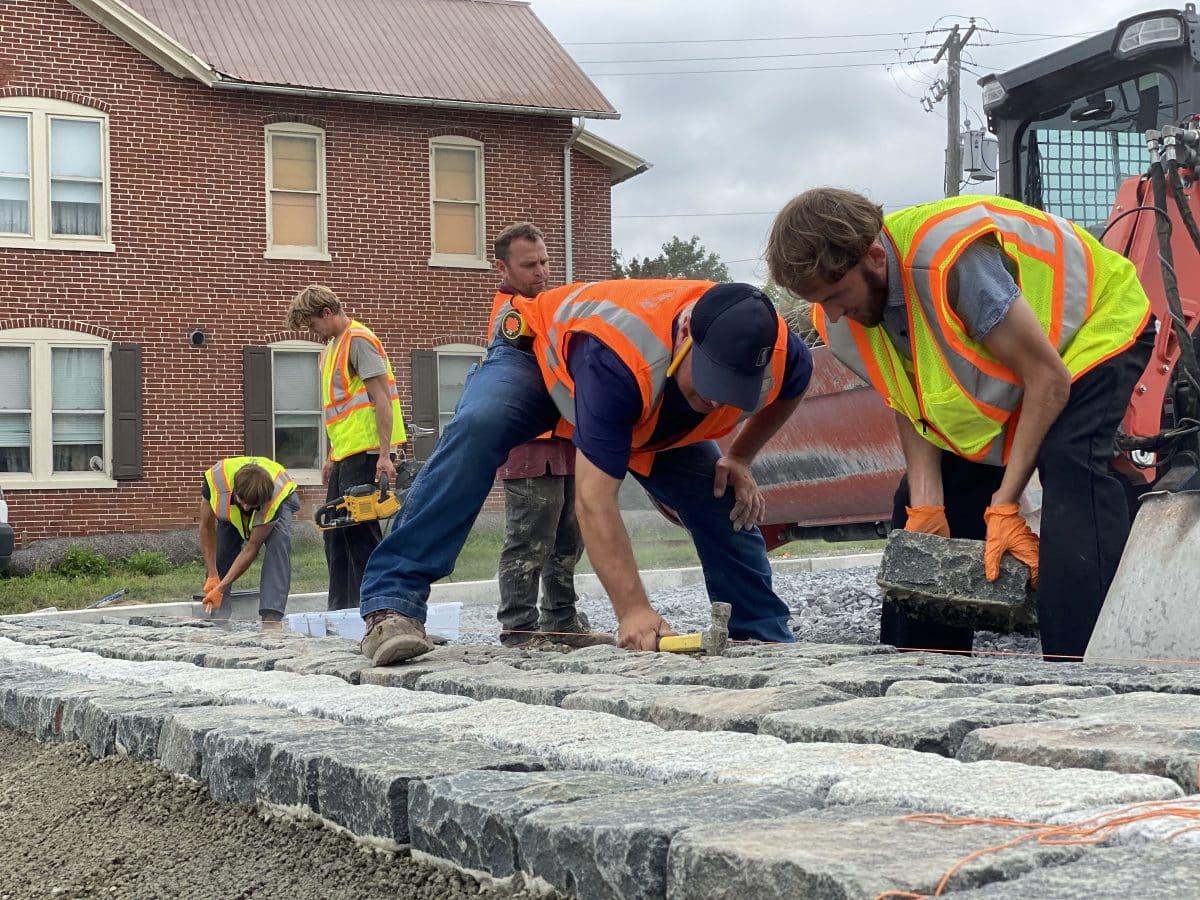
Tag: Hardscaping

Ultimate Backyard Lancaster: A ‘Once-in-a-Career’ Hardscaping Project

Jeremy Martin, owner of Willow Gates Home & Landscape, first received a call from his client about the “Ultimate Backyard Lancaster” project in summer of 2023. Martin was on vacation at the time, but he was so intrigued by his client’s description of their dream project that he felt compelled to respond immediately.

“It was the kind of project that comes along maybe every 10 years, maybe once in a career,” Martin said.

Ultimate Backyard Lancaster would eventually go on to win the Segmental Concrete Pavement – Permeable category and earn an Honorable Mention in Outdoor Living Features category at the 2025 Hardscape North America Awards.

But the Ultimate Backyard Lancaster isn’t just an award-winning project. It’s proof that even the most ambitious visions can become reality when every detail is treated with care.

Building a Dream

Martin’s client had been planning this project since 2015, when he first built his home. By the time he reached out to Martin, the architectural drawings for the entertainment barn the project included were mostly complete, but the real work was just beginning.

Martin thinks and designs in 2-D. For this project, he started with the two largest features: the barn footprint and the pool dimensions. From there, he built outward, carefully considering how each element would flow together.

In addition to the barn and pool, the client also initially requested a full half-court basketball court. Once Martin showed him what that would require, they scaled back to free throw lines and other basketball court elements so the final look would still be impressive, but not overwhelming.
Finding the Right Materials

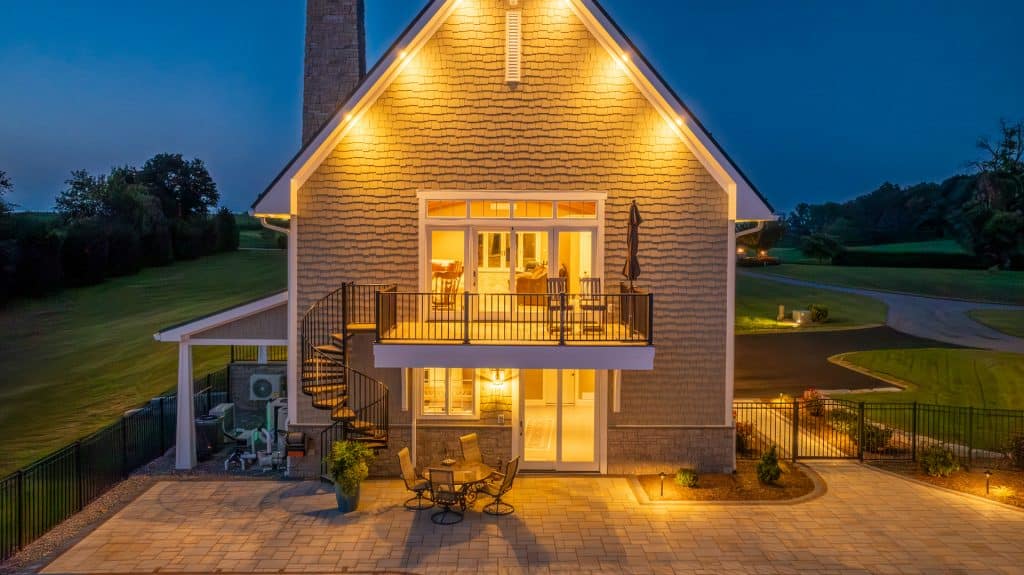
“One of the guiding principles was this had to look like it’s built at the same time as the home, despite being 10 years later,” Martin said.

That guiding principle would shape every design decision for Martin.

The property also already featured outdoor living space built in 2017, complete with a bocce court and outdoor kitchen. Rather than forcing a perfect match with the older materials, Martin took a thoughtful approach.

All retaining walls and the barn used a natural stone veneer that matched the outdoor kitchen and closely coordinated with the house. This created cohesion instead of contrast.

“I really hated the idea of adding in yet another color, another texture,” Martin said. “I didn’t want it to be a complete fruit salad of everything thrown in there.”

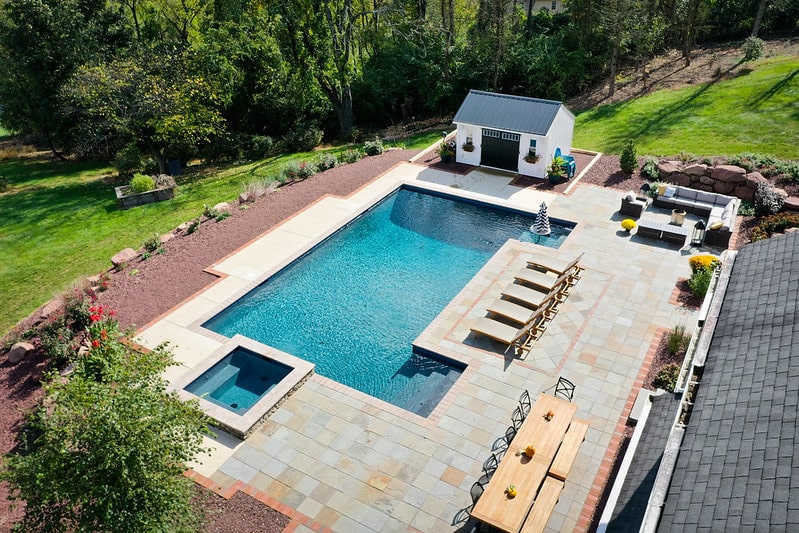
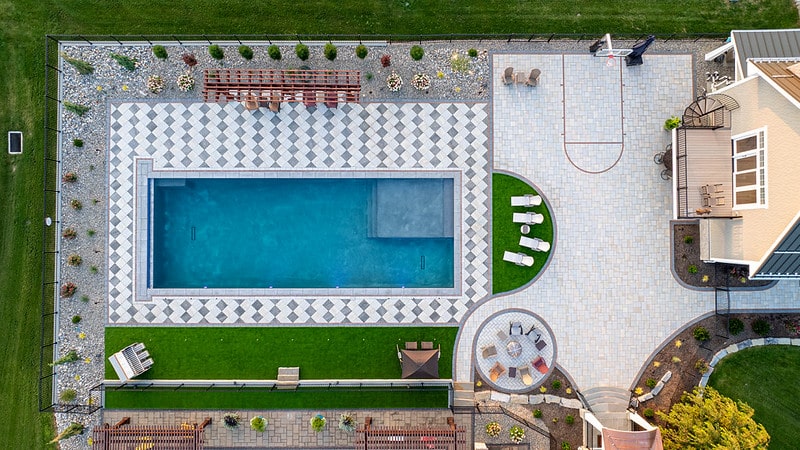
For the pool patio, the client fell in love with the texture of Techo-Bloc’s Everest paver and wanted it in a diamond pattern using three colors: very dark gray, light gray, and medium tan.

When the client initially requested mixing all three colors in three different sizes throughout the large patio in addition to the pool, Martin pushed back.

“I said, ‘That’s just way too busy. We need to dial it back,’” Martin said.

Instead, Martin used the same color palette in much more muted tones—very light gray, very light cream, and very light tan—for the main patio. The result was visual interest without overwhelming the massive space.

“I love it. I think that really brought it all together. Those colors came together perfectly,” Martin said.

Sweating the Details

The curves in this project stand out as the most challenging and rewarding elements for Martin.

Martin wanted the semicircle at the shallow end of the pool, a curved walkway, and a circular fire pit seating area to flow together perfectly. He spent hours during the design phase ensuring these curves aligned, then duplicated that precision in the field.

“Those are the little details that I really sweated,” he said. “They were really important to me, and you’re like, ‘is it really worth it?’ You look at a picture at the end, and, yes, it was worth it. Those curves all are pretty much perfect.”

The same attention to detail extended to the diamond pattern around the pool. Martin designed the borders and everything to work with full and half diamonds—no slivers anywhere. All four sides were laid out meticulously to avoid any partial cuts.

The Permeable Challenge

Adding nearly a quarter acre of impervious surface in Pennsylvania’s Chesapeake Bay watershed meant serious stormwater management requirements. The project needed a 100-year stormwater plan capable of storing 7.5 inches of rainfall.

The solution required making the entire patio and all artificial turf areas permeable with a 20-inch base.

“It’s kind of crazy. We didn’t need that much base, it’s simply a patio, but we had to store 7.5 inches, and that’s what it came out to be,” Martin said.

The team also constructed a massive infiltration bed measuring 30 feet wide by 90 feet long and 30 inches deep for the barn, driveway, and other improvements.

“Permeable truly does make sense. It’s good stewardship. It’s good management, and given you’re building a patio anyway, we’re already putting a base in. To make it deeper and put stormwater management underneath it just makes sense in a lot of cases,” Martin said.

A Year in the Making

From initial contact with the client to getting permits in hand took a full year. Stormwater planning alone consumed over half that time.

Installation continued right up until winter arrived, with the team working as snow was flying and temperatures dropped into the teens.

But the most rewarding moment came during installation. Martin arrived one Saturday to find his client playing basketball with his granddaughter on the not-quite-finished court.

“This really kind of encapsulated why he wanted to build this. It’s for his family and his friends. It’s not a public space, he’s not renting it out, this is just a place for him to hang out with his friends and family,” Martin said.

“It’s easy to lose sight of that when you’re building something this over the top, but at the end of the day, that’s what it’s for. He’s hosting people there constantly, family, friends, board meetings. He built this place to be used. It’s not just something to show off with. This is a place he wanted to use, and he is. He’s using it all the time.”

Details Over Scale

The scale of this project is staggering. More than 4,500 square feet of pavers isn’t something you see often.

“Everyone who’s seen this project is kind of mind-boggled by the sheer scope,” Martin said. “I do view it as very much a privilege and an honor to be able to build this for the client.”

Winning in two categories at the 2025 HNA awards validated all the hard work Martin and his team put into the project. For aspiring hardscapers who want to one day work on their own award-winning projects, Martin encourages them to focus on the details, not just the scale.

“Details matter,” Martin said. “Just the sheer scope of a project or sheer scale isn’t really the most important thing. So yes, this is an amazing project, a once-in-a-lifetime project that I never even would have dreamed of. But it’s really the little details that matter, whether it’s a big project or a small project.”

He points to the clean diamond pattern around the pool, the perfectly flowing curves, the muted and coordinating color palettes. These are the elements that elevate good work to exceptional work.

“If you lay a 5,000-square-foot patio and there’s no character to it, the joint lines aren’t straight—you missed the point, you know?” Martin said. “I don’t want to do that kind of work. To me, it’s not the sheer size. I care about the details.”

His client’s decade-long dream is now a showcase of what’s possible when scale meets meticulous hardscaping craftsmanship.
Beyond the Classroom: Why One Professor Takes His Students to Compete at Hardscape North America

Brigham Young University’s landscaping program works to shape the next generation of outdoor design professionals. These students have the opportunity to not just learn in the classroom, but to also gain experience on a national stage.

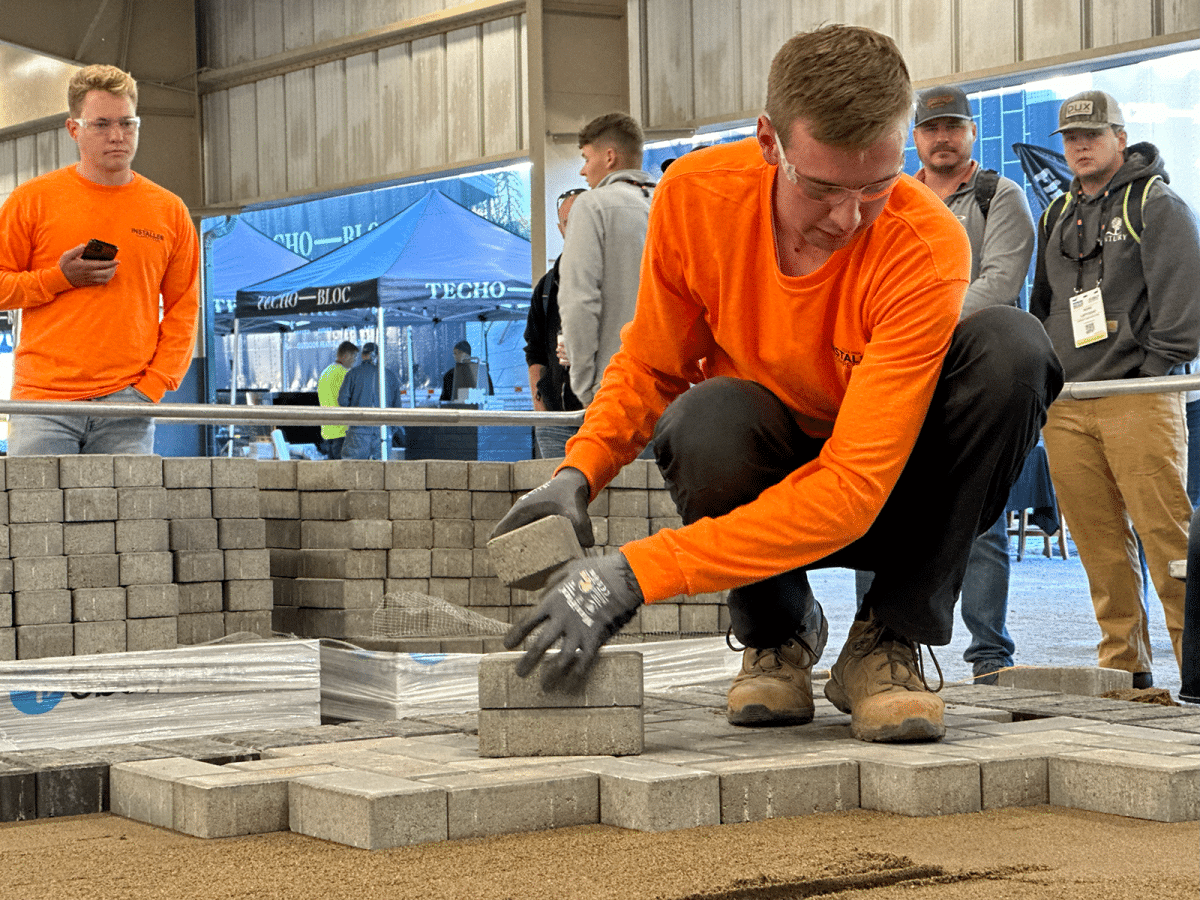
Greg V. Jolley, PLA, ASLA, Professor of Plant and Landscape Systems, often brings a team of students to the annual National Competition at Hardscape North America, where they test their skills against some of the best in the country.

But for Jolley, the competition isn’t just about trophies. It’s about giving students real-world confidence, hands-on experience, and the chance to see themselves as future leaders in the industry.

From Theory to Practice

Jolley’s own path to teaching started after five years of professional practice at a landscape architecture firm in Jackson, Wyoming. When an opening came up at his alma mater in 2003, he jumped at the chance to return. For him, this was a return not just to BYU, but to the same campus where his father had been a professor.

“To be able to go back and have the opportunity to teach in the same place he did, and to be able to teach the topic I loved, it was a no-brainer,” Jolley said.

That real-world experience has proven invaluable in the classroom. Four-year universities excel at teaching theory, Jolley noted, but hands-on skills can be harder to incorporate into the curriculum.

That’s where competitions like Hardscape North America come in.

Hands-On Learning, Real-World Results

BYU has been involved in landscape competitions since the late 1990s, and Jolley has been part of that effort since he arrived back on campus. To bridge the gap between classroom learning and practical skills, he formalized a partnership with BYU’s grounds department in 2003, requiring all students to work there for at least one semester.

“Most students would end up working for more than just one semester,” Jolley said. “They may end up working for two years, three years. If they get into that program early enough, sometimes even gain four years of experience.”

Competitions build on that hands-on foundation by offering a deep dive into specific skills.

“In the case of hardscape installation, just in the preparation leading up to a competition, they can gain hours upon hours of experience,” Jolley said. “It gives them a little bit more depth in the subject than we could otherwise provide as professors or in an academic setting.”

When Jolley asks students about their competition experience, one word comes up repeatedly: invaluable.

“Just to be able to observe professionals doing the work and being able to talk with them and get feedback from them. You have such skilled laborers installing these hardscapes, and just being able to watch them for a couple of rounds of the competition is invaluable,” he said. “I think it generates more ideas in their mind of ways that they can go about their work.”

More Than Just Hard Skills

Jolley also emphasizes that competitions teach soft skills, critical skills that every professional needs.

“We oftentimes think of the install as being just hard skills and that’s it,” he said. “But the soft skills of communication—how do you communicate with one another? How do you problem solve? You might be in the middle of the competition and you have to pivot or adjust what your original strategy was.”

Jolley also encourages his students to stay connected with professional associations, to educate others, and to support their fellow practitioners.

“We want our students to have as they go out into the world a desire to continue to learn and continue to serve in whatever communities that they’re in,” he said.

It’s a philosophy reflected in BYU’s motto: “Enter to learn, go forth to serve.”

“We try and emphasize that to our students that go out into the industry,” Jolley said. And it’s a principle he embodied in his own career trajectory from student to practitioner to educator.

Whether students end up installing patios, designing outdoor spaces, or another industry entirely, the skills and connections they gain at competitions like Hardscape North America become part of a foundation that lasts a lifetime.

Entrepreneur vs. Employee: Which Path is Right for Aspiring Hardscapers?

Every hardscaper faces a big decision at the start of their career: should you begin by building your own business or gain experience by first working for someone else?

Both routes have their pros and cons. Running your own company means independence, but also risk; working as an employee offers stability and mentorship, but less freedom.

If you’re an aspiring hardscaper wondering where to begin, advice from a few industry professionals can help you find the path that fits your personality, goals, and lifestyle.

Learning Then Leading

Dan Hughes, President of Segmental Systems Inc., spent nine years working for a landscape company before eventually purchasing an established hardscape business. That time as an employee was an education.

“I constantly observed how things were done, good and bad, and compared it all to other companies in the area,” Hughes said. “I learned all the basics of landscaping, sprinklers, different construction methods, and even some landscape maintenance.”

More importantly, he gained crucial management experience.

“The longer I was there, the more experience I got running/managing crews, dealing with customers, knowing what we needed for supplies for the day, planning for the next several days, equipment repair and usage,” he said.

However, Hughes is candid about what he didn’t learn as an employee.

“What I never learned was sales, estimating, overhead, payroll, taxes, and the business end of it all,” he said.

When Hughes started working for Segmental Systems with the intent to purchase it, the owner made it his mission to teach him as much as he could during the transition.

Looking back, Hughes appreciates the foundation his employment years provided, but he also acknowledges the value of buying into an established operation.

“You avoid the struggles of having to do all the work yourself while still trying to find work and build a business. That’s a tall hurdle and I applaud those who have done it successfully. It’s a grind to get there for sure. But buying something existing, partnering up with an established business allows you to focus on building and making things better rather on fighting to survive,” Hughes said.

“…If I were to do it all over again, I would definitely work in the trade for a quality contractor and look to buy in or out that company. Starting from scratch is quite risky, and extremely volatile in the dips in the economy.”

Finding the Right Employer

Weston Zimmerman, founder of SynkedUP, experienced a transformative shift in how he viewed employment, one that ultimately prepared him for entrepreneurship.

Starting as a teenager at Tussey Landscaping installing water features and koi ponds, Zimmerman admits he was initially “your average employee” who “worked hard when I was there, but I wanted the Fridays off and I wanted to go do this, I want to go do that.”

Everything changed after he got married and his priorities shifted. At an Aquascape convention in Chicago, hungry to make more money, he approached CEO Greg Wittstock about job opportunities.

“He looked at me like I had three heads,” Zimmerman said. “And I said, ‘Well, I just want to make more money,’ and you can see that he had heard this 100 times. He said, ‘Go back and talk to your boss and ask him what can you do to make the company more money, so that you can make more money.’”

Zimmerman never looked at employment the same way again.

“My mindset, my perspective as an employee shifted forever from that moment on,” he said.

That shift led Zimmerman to become not just a crew lead, but also Director of Marketing at Tussey, launching their social media presence, YouTube content, filming and editing, and managing their website.

Both Zimmerman emphasizes that not all employment experiences are created equal.

“There’s a key ingredient that has to exist and that is the owner of that company has to be willing to give you the autonomy. I could’ve had the exact same story at Tussey Landscaping, but with a different owner that wasn’t willing to give me the rope to climb and it would’ve failed for both of us,” Zimmerman said.

Instead, Zimmerman was able to really have a seat at the table at Tussey and started to offer ideas for business processes and process optimization. That experience eventually led him to founding SynkedUP, a software company that’s transforming how hardscaping businesses operate.

“I actually would probably encourage going and working for someone for a while, but I would also say in the same way that the employer is interviewing you, in your own mind be interviewing the employer,” Zimmerman said. “If you’re going to work for someone, be considerate and thoughtful about who you’re choosing to work for because that’s a key part of the equation in making that successful.”

Built for Independence

Outside of three years in the military, Gary Stowe, President of Stowe Contracting, Inc., has worked for himself since he was 13. For him, entrepreneurship isn’t just a preference, it’s a necessity.

“I’m not a good employee,” Stowe said. “That’s kind of what people need to understand if they want to go in business. It can’t be, ‘I’d like to go in business.’ It’s, ‘I have to go in business.’”

Stowe’s career path in hardscaping has been unconventional. With a nursing degree and three years in the Army, he spent a decade running an auto repair shop before transitioning to construction in the late 1980s. But while these fields seem widely varied, Stowe said they all really come down to his passion for fixing things.

Each career shift also taught him something valuable about business operations, pricing, and customer relationships, lessons that helped him build a successful hardscaping company.

One pivotal lesson came during his struggling years in the auto repair business. Working 70-hour weeks, he accompanied his wife to their accountant for tax preparation. The accountant looked at their returns and said, “You know, you can apply for food stamps if you want.”

“That was kind of an epiphany for me,” Stowe said. The turning point came when he realized he needed to bid jobs properly and account for real overhead costs. “You can’t look at the job—the parts, the pieces of the job, the labor it takes to do the job—that’s only one small part of it. You’ve got overhead of just being in business, and you have to recognize that.”

For Stowe, the appeal of entrepreneurship is clear.

“The ability to make your own decisions, the flexibility to do that. The ability to turn down customers if it becomes necessary, to pick and choose who your customers are, the type of work you want to do,” he said.

He acknowledges the demands are real and that it is not a traditional 9-5 job. He keeps a notepad by his bed because he wakes up thinking about work and he stresses the constant planning and organization required to run a company. But despite the challenges, he’s found deep satisfaction in his path.

“It’s a very fulfilling lifestyle. It’s a great way to employ yourself and others,” he said. “It gives you a great deal of satisfaction, and it’s well worth all the heartache that you go through.”

The Employee’s Path

Elias Null, Optimas Specialist at Pave Tool, pushes back against the cultural assumption that entrepreneurship is the only path to success or fulfillment.

“Society pushes to have your own business and be your own boss. And that’s great! That really is awesome, but different personalities are different, and you don’t actually need to be your own boss to have a good life,” Null said.

For him, the focus isn’t on titles or ownership, it’s on personal growth.

“The goal for myself would be to be the best version of myself that I can be,” he said. “Life is like a creek, and if you’re just sitting on a creek in a kayak or canoe, you’re going to end up downstream. You have to stay rowing upstream if you’re going to have a better life.”

Null’s perspective is a reminder that career success isn’t one-size-fits-all. For those who thrive in structured environments and prefer to focus on craft over business operations, the employee route can be just as rewarding.

Finding Your Path Forward

Determining the right path for you really depends on honest self-assessment. Consider these questions:

  • Are you willing to learn the business side? As Hughes and Stowe discovered, field skills alone won’t sustain a company. You need to understand estimating, overhead, taxes, and cash flow or be willing to learn.
  • Are you energized or drained by business management tasks? If paperwork, bidding, payroll, and planning excite you—or at least don’t exhaust you—entrepreneurship might fit. If you’d rather focus purely on the craft, employment could be your path.
  • How do you handle uncertainty and financial pressure? Hughes notes that even with an established company, “there were a few times where work was sparse. Very stressful when you have a fairly large monthly payment on a business.” Can you weather those storms?
  • Do you need autonomy to be happy? Stowe’s realization that he couldn’t work for others came from recognizing his personality. Some people thrive with structure and clear expectations; others suffocate under them.
  • Can you find the right mentor? Both Zimmerman and Hughes benefited enormously from employers willing to invest in their growth. If you choose employment, choose carefully.

There’s no single right answer. The hardscaping industry has room for all approaches.

Whether you choose to work for a quality contractor, buy into an existing business, or strike out on your own from day one, success comes down to dedication, continuous learning, and being honest about who you are and what you need to thrive.

How to Break into the Hardscape Industry

According to the recently released 2025 Contractor Industry Report from the Concrete Masonry & Hardscapes Association (CMHA), the top three ways hardscape contractors recruit employees are:

  1. Word of mouth/staff recommendations (84%)
  2. Internet job listing services (50%)
  3. Company websites (42%)

If you’re looking at this list and thinking, “Word of mouth sounds great, but I don’t know anyone in the industry,” you’re not alone.

The good news? You don’t necessarily need connections to break in. You just need the right approach.

The Research-First Approach

Frank Bourque, a landscape and hardscape business consultant and founder of the Landscape & Hardscape Business Success Summit, explains that word-of-mouth hiring isn’t just about having hardscaping insider connections.

He said you don’t need to know someone to get hired in the hardscape industry, as long as you do your homework first. Bourque’s approach centers on genuine research and personalized outreach.

Before reaching out to any company, you need to become genuinely familiar with their work, he said. This means diving deep into their website to understand their services, values, and recent projects.

Social media can be your window into their company culture. Scroll through their Instagram and Facebook to see not just their finished work, but how they present their team and approach their craft. Pay attention to their equipment and capabilities, noting what types of projects they specialize in.

The goal isn’t just to gather information for the sake of it. You’re looking for specific things you genuinely admire about each company so you can speak authentically about why you want to work there.

Make a Personal Connection

Once you’ve done your research, Bourque suggests making a personal connection through thoughtful outreach.

Try sending a personalized email. The following template is based on Bourque’s approach, but it is always better to use your own words to show that you’ve done your research! For example:

Dear [Owner/Manager Name],

I hope this message finds you well. My name is [Your Name], and I am writing to express my interest in potentially joining your team at [Company Name].

After researching your company extensively, I am impressed by the quality of work showcased on your website and social media platforms. Your recent [specific project/post] particularly caught my attention, and it’s clear that your team maintains high standards and takes pride in their craftsmanship. I was also impressed by [specific equipment/capability/value you noticed] and the professional way your team presents themselves online.

I am actively seeking to begin my career in the hardscape industry and am drawn to [Company Name] because of [specific reasons based on your research – their approach, values, types of projects, etc.].

While I may be new to hardscaping, I bring [relevant skills/experience/qualities] and am eager to learn from experienced professionals.

Would it be possible to schedule a brief meeting to discuss potential opportunities with your team? I would welcome the chance to learn more about your company and share how my background and enthusiasm could contribute to your continued success.

Thank you for your time and consideration. I look forward to hearing from you.

This approach demonstrates that you’ve taken time to understand their business. You’re not just looking for any job. You’re interested in their company in particular.

The Power of the Follow-Up Question

Perhaps the most important part of Bourque’s strategy comes when a company can’t hire you immediately. Instead of walking away disappointed, he suggests asking one crucial question: “What advice would you give to someone with my background and experience?”

This question transforms a rejection into a learning opportunity and often opens doors you didn’t expect.

The company leader might tell you exactly what skills to develop to become hireable later or they might offer you a different position that could lead to what you ultimately want. Sometimes they’ll even reconsider their initial response and find a way to bring you on board.

Why This Personalized Research-First Approach Works

This approach makes hardscaping businesses feel recognized and appreciated for their work.

“I almost guarantee that your name is going to pop up somewhere high on the list when they need to interview,” Bourque said.

With this approach, you don’t wait to be recommended. Instead, you actively shape the word of mouth about you as an aspiring hardscaper.

“For anyone trying to get in, just sell that first job. Knock on doors, pitch a small walkway or patio, even offer to do cleanup or base prep for another established hardscape contractor. Don’t wait for a golden referral – create your own momentum,” said Sam Gembel, the Owner and Founder of Atlas Outdoor. “The best hires I’ve made didn’t have a ton of experience or connections. They had grit, showed up, and proved they belonged. We can train the knowledge and build the experience.”

When you demonstrate that you’ve noticed what they do and that they seem to be doing it well, people pay attention. It shows genuine interest, initiative, and respect for their expertise.

Making Online Applications Work

While personal outreach is powerful, don’t ignore internet job listings – the second most common way hardscaping contractors hire.

When you do apply through job boards, treat each application like a mini version of the personal approach. Reference specific projects you’ve seen on their website, highlight transferable skills from other industries, and express genuine enthusiasm for learning the trade rather than just needing employment.

“A personalized message or a short video beats a cookie-cutter résumé every time,” Gembel advised.  

Company websites, the third most common recruitment tool, should be your research goldmine. Use their career pages, project galleries, and company information to understand their specialties and values. Then incorporate these insights into your outreach, whether it’s through their website contact form or a direct approach.

Beyond Your First Job

As you gain experience in the hardscape industry, your reputation becomes even more important. Numerous opportunities open up. You might continue working for contracting companies, move into positions with suppliers, transition into teaching and training roles, or eventually start your own business.

Bourque emphasizes that you can “move up really quick if you are around the right people,” making that first job crucial for building the right network and learning from experienced professionals.

The key is viewing your first position as the foundation for a long-term career rather than just a paycheck. When you approach it with this mindset, you’ll naturally gravitate toward companies and people who can help you grow.

“Reputation is currency. Once someone’s in the door, that word travels fast. The best way to build a solid name in this trade is to show up early, over-communicate with clients, own your mistakes, and make the jobsite better than you found it,” Gembel said. “…Clients remember, crews talk, and opportunities follow. Good or bad, your name becomes your brand, so build and protect the heck out of it. At the end of the day, the industry still rewards those who hustle, stay humble, and get the results.”

The Industry Need is Real

The CMHA report identifies workforce shortages as one of the most significant challenges facing hardscape contractors – a consistent concern from 2017 through 2025. This means companies are actively looking for motivated individuals willing to learn the trade.

Your job is to show them you’re worth taking a chance on, even without industry experience.

The hardscape industry offers excellent opportunities for those willing to work hard and learn.

While word-of-mouth hiring might seem like a barrier, it’s actually an opportunity to stand out through genuine interest, thorough research, and professional approach. Your career in hardscaping starts with that first conversation. Make it count.

Commercial vs. Residential Hardscaping: Which Path is Right for You?

For those considering a career in hardscaping, one of the decisions you may face is whether to focus on residential projects or commercial installations.

While the fundamental techniques may be similar, these two paths offer different experiences, challenges, and rewards. As an aspiring or early career hardscaper, it is worth exploring both to see which might be the right fit for you. 

Understanding the Two Paths

At its core, hardscaping involves the same materials and installation techniques whether you’re working on a backyard patio or a shopping center plaza. The primary differences lie in the scale, design process, client relationships, and business operations.

Residential projects commonly are referred to as Design-Build. This is because the contractor provides both the design and build services to the homeowner. Most commercial projects are Design Specification where the owner provides details, developed by a third party, of the methods and materials needed to achieve the wanted outcome. In commercial projects the hardscape contractor is usually a subcontractor, typically working for the general contractor who in turn has a contract with the owner.

Residential hardscaping typically involves working directly with homeowners on custom projects for their personal property. These jobs might include backyard patios, walkways, outdoor kitchens, fire pits, and retaining walls—all designed to enhance a family’s outdoor living experience. The work is highly personalized, often creative, and involves significant client interaction.

Commercial hardscaping usually involves larger-scale projects for businesses, developers, or government entities. These might include parking lots, plazas, walkways for shopping centers, or hardscaped areas for apartment complexes. The work tends to follow pre-established plans created by landscape architects or engineers, with less room for on-site creativity but greater emphasis on efficiency and adherence to specifications.

Understanding Payment Terms
For most residential projects payment terms favor the contractor. Usually there is a large, up front payment and final payment is due within days of completion.

For commercial projects payment terms generally favor the owner and/or general contractor. Payment terms are defined by the contract. Payments often don’t start until there is materials on site and they are typically due in 30 or 60 days after invoicing. Depending on the contract, there may be progress payments. Payment for completion of the project may take even longer and it isn’t uncommon to have 120 days. Also there is typically a 10% retainage/holdback which is kept to address issues that may appear well after the completion date. Retainage/Holdbacks may take a year or more to be released. Subcontractors don’t get their retainage/holdback until the owner releases the GC’s retainage/holdback and this may not even happen due to issues related to other subcontractor’s work, over which you have no control over.

Residential projects are typically smaller in scale, so you can do more in a year, lower total cost, but they earn higher margins.

Commercial projects are typically larger in scale, so you will only do a few a year, they have a higher total cost, but lower margins. Focusing your company on a specific market and optimizing your company based on these general principles can make your company very profitable.

The Residential Experience: Creativity and Connection

Harrison Woytko, President of Boulder Landscape, LLC, primarily focuses on residential projects. He was drawn to this sector for its creative possibilities and the opportunity to provide excellent customer service.

“From a creativity and expanding your knowledge perspective, I think the residential market offers much more,” Woytko said. “If you’re someone with creative skills or if you want to see different projects at different houses in different neighborhoods and meet different homeowners, there’s lots of opportunity and freedom there.”

This variety extends beyond just creative expression. Residential hardscapers often build meaningful relationships with their clients.

“We’re pretty good at the back-and-forth with a residential customer. We’re good at having a kitchen table talk. We can listen to somebody and we can pivot and come up with a better solution or something that’s more tailored for them,” Woytko said.

These personal connections often make the work more rewarding.

“Homeowners might have saved their money for 10 years to build a patio so they’re invested,” said Frank Gandora, President of Creative Hardscape Company. “You have great interaction with these people. They’re grateful that you’re doing it, and it’s a very positive situation.”

Woytko said that customer service piece also plays a role when hiring for his team.

“From a hiring perspective, we’re looking for someone with a positive attitude along with good customer service skills. It doesn’t mean that every employee has to have a one-on-one conversation with the homeowner when they come home every day or that they have to make the sale and engage them, but it’s important that they’re respectful, have a good attitude, and have social intelligence when it comes to interacting with others,” he said. 

The Commercial Landscape: Scale and Structure

Commercial hardscaping offers its own set of advantages and challenges. These projects are typically larger in scale, more structured in their execution, and often involve working with other construction trades as part of a larger development project.

“In commercial work, you have engineers, you have architects, a landscape architect. They designed the plans. They create the elevations. They create all the data you need to do a commercial job. There are plans, specifications. They tell you the methodologies and how to install it in most of the cases,” Gandora said.  “What’s being used on a commercial job is your labor.”

These projects present the opportunity to hone in on a particular skill—such as laying pavers across expansive plazas or courtyards—and execute it with precision. They also highlight how strong teamwork and coordination are essential to bringing large-scale visions to life. With multiple teams working in tandem under tight deadlines and strict specifications, commercial hardscaping becomes a lesson in efficiency, communication, and collaboration.

Finding Your Path Forward

Ultimately, the choice between commercial and residential hardscaping isn’t necessarily permanent. Many professionals start in one sector and transition to the other as they gain experience, move locations, or as market conditions change.

“I don’t know if you have to pick an avenue. I just think it’s how you can cater to your customer, whether that customer is a large general contractor or production home builder or Mr. and Mrs. Jones with a residential project on their home,” Woytko said. “For someone just getting into the business or maybe starting to work for a company, I think it’s really dependent on your market and where you see your vision going.”

Mixing Concrete and the Environment: How Hardscaping Supports Sustainability

Today’s job seekers are often looking for more than just a paycheck; they want purpose. Finding work that aligns with personal values can transform a job into a fulfilling career.

For those who care deeply about environmental resilience and sustainability, the hardscaping industry combines creativity, technology, and environmental problem-solving into real-world results.

Mimicking Natural Systems

The environmental benefits of modern hardscaping techniques extend far beyond what most people realize.

“Permeable Interlocking Concrete Pavement is probably the most visible technology we’ve got that is environmentally focused,” said Robert Bowers, VP of Engineering – Hardscapes at the Concrete Masonry & Hardscapes Association (CMHA).

Permeable pavers absorb and detain rainwater, allowing it to slowly infiltrate into the ground instead of overwhelming municipal infrastructure. This distributed approach reduces runoff volume, minimizes erosion, and lessens the strain on aging stormwater systems.

“Instead of a one-hour storm event overloading the city’s stormwater infrastructure, we can spread that release over days. That’s a major benefit,” Bowers said.

And the environmental upsides don’t stop with water retention. It can also act as a filtration system, filtering out contaminants like total suspended solids, hydrocarbons that leak from vehicles, and even heavy metals. Permeable pavement can also cool water before it enters creeks and ponds, helping protect aquatic life from thermal pollution.

“It’s acting in a lot of different ways. Permeable pavements mimic our natural wetlands better than any other system that we’ve got,” Bowers said. “It captures the water. It filters the water. It detains the water and it replenishes our ground water. It provides a lot of those similar functions a wetland would have.”

Expanding Sustainable Development

The environmental benefits of hardscaping extend beyond permeable pavements. Segmental retaining walls provide another sustainability opportunity by enabling development of previously unusable land.

“The prime land has been used in most cases,” Bowers said. “What is left is often vacant lots with slopes that make them not ideal to build on.”

Retaining wall systems create level areas on these overlooked properties, helping to control urban sprawl by enabling more efficient use of land within existing boundaries.

“Instead of cities continuing to expand outward, they can start looking inward and see which properties they’ve passed by that they should consider,” said Bowers.

Durability is another environmental asset.

“Concrete has been used for thousands of years and it’s proven its durability and longevity,” Bowers said. “It weathers extreme storm events better than many alternatives, and that’s essential in a world where those events are becoming more frequent.”

Relying on Reusable Elements

Hardscaping also leans heavily into materials that can be reused. Unlike some methods that require demolition and disposal when changes are needed, interlocking pavers stand apart with their remarkable reusability.

Bowers shared an example from the University of New Hampshire. When campus expansion required building on an area where Permeable Interlocking Concrete Pavers had been installed, the university didn’t simply demolish the pavement. Instead, they carefully removed the pavers, stored them during construction, and then reinstalled them for the new building’s pavement needs.

“The impacts of manufacturing a new product were eliminated. The product was already there so they didn’t have to use additional aggregate and cement and the energy to produce them and deliver it to the site. It was all there already,” Bowers said. “Being reusable is a huge benefit.”

The sustainability benefits extend beyond large institutional projects to the residential level.

Pavers can be reused if the homeowner wants to reconfigure the area or needs other changes. This isn’t possible with traditional asphalt or poured concrete slabs.

Training for a Greener Future

If you’re interested in entering the field with an emphasis on sustainability, Bowers recommends seeking certifications for the installation of permeable pavement systems, interlocking concrete pavers, and segmental retaining walls.

For instance, the CMHA Permeable Interlocking Concrete Pavements (PICP) Installer Course covers how to properly build systems that allow stormwater to filter into the earth—turning what was once treated as waste into a resource. It teaches not just the installation techniques, but also the science behind why these systems and materials matter.

“From a design perspective, from an engineering perspective, understanding how the system works, how it integrates and connects with the other systems in a built environment is important. There’s also the maintenance side,” Bowers said. “CMHA is positioned to support those different aspects or roles with training, information, and materials.”

CMHA’s educational offerings empower professionals across construction, design, and maintenance to build hardscapes that are not only beautiful and functional, but also climate-smart, scalable, and resource-efficient.

Hardscaping might not be the first thing that comes to mind when you think of green careers, but with the right training, the industry offers the chance to build something that benefits both communities and the environment.

Learn more about CMHA’s offerings and get started on your own values-driven career path.

Reputation Matters in Hardscaping: Building a Reputation Through Quality Work

Hardscaping is a trade built on trust, relationships, and reputation.

Delivering high-quality work is one of the most effective ways to establish a strong professional reputation. A well-executed project not only satisfies your client but can also lead to repeat business and valuable word-of-mouth referrals.

Reliable and Trustworthy

Your reputation is your most valuable asset in the hardscaping industry. When clients and contractors know they can count on you for top-tier work, they’re more likely to refer you to others and bring you back for future projects.

“For job seekers in the hardscaping industry, reputation is everything. Start by mastering the fundamentals—pay attention to detail, work efficiently, and always strive for quality. Be reliable and professional in every situation, no matter how large or small the opportunity is,” said Trevor Fearn, VP Operations at CornerStone Wall Solutions Inc.

Andrew Vear, a longtime installer and consultant, also emphasized the importance of reliability and trust. He recommends maintaining strong relationships with past clients.

“They’ve already done business with you, they already trust you. They’re the best people to do business with,” Vear said.

A Job Well Done

Jason Stewart, owner of JPAVE, shared that having a reputation for high-quality work has earned him repeat business and new contracts. “I get hired in a lot of times because of my quality, and to clean up somebody’s mess,” Stewart said.

For Nelson Braybrook, owner of Call Nelson Landscaping in Mississauga, Ontario, word-of-mouth referrals have been a driving force in his success. One of his early projects led to a lasting connection with a family who was so impressed with his craftsmanship and professionalism that they sought him out and tracked him down years later, even after he left his previous company. That single job sparked a chain reaction, with their friends and colleagues at the local college continuing to recommend him.

“Somehow, I ended up in this college network with everybody,” he said. “And it just worked out really well.”

Braybrook attributes this loyalty to the high standards he sets for himself and his work. Clients know they are getting quality craftsmanship, honest service, and a finished project they can be proud of.

“They know they’re getting a good job. They know their money’s not going to get stolen from them, and they’re not just going to get generally ripped off,” Braybrook said. “They know they’re going to get a quality project.”

A job well done doesn’t just lead to satisfied clients—it creates advocates who will recommend you to their friends, family, and colleagues. On the flip side, poor craftsmanship can do just as much damage to your career as quality work can build it.

“If you can get three referrals from a good job, that’s great,” Vear said. “But 100 people will see a bad job.”

Sloppy work, delays, and lack of professionalism can quickly tarnish a hardscaper’s reputation, making it harder to land jobs in the future.

The Role of CMHA in Building Your Reputation

Organizations like the Concrete Masonry and Hardscapes Association (CMHA) provide hardscapers with valuable training, certifications, and mentorship to help them refine their craft.

“Always be willing to learn and grow—whether that means seeking mentorship, taking certification courses, or attending industry events,” Fearn said.

By taking advantage of these resources, professionals and aspiring hardscapers can gain the skills needed to consistently produce high-quality work that builds their reputation.

While quality work is a key driver of success, reputation is also built through professional networks. Be sure to check out our companion blog post, Reputation Matters in Hardscaping: Building Your Reputation Through Professional Networks, on how networking and industry connections can take your career to the next level.

Reputation Matters in Hardscaping: Building a Reputation Through Professional Networks

While delivering high-quality work is essential for building a strong reputation in hardscaping, professional relationships play an equally crucial role.

Networking within the industry can lead to new opportunities, collaborations, and valuable mentorships that help long-time hardscapers and aspiring hardscapers grow in their careers.

The Importance of Community and Mentorship

Cultivating strong professional relationships can open doors to new opportunities and ensure a steady flow of projects.

“Word-of-mouth has been one of the most influential factors in my hardscaping career. Building strong, respectful relationships helps you become a top choice for referrals. One of the fastest ways to achieve this is by responding to all inquiries promptly—whether you have the answer or not. Quick responses show that you’re engaged, reliable, and committed to addressing people’s needs, which builds trust and confidence. While it may seem simple, this habit fosters respect and strengthens professional connections,” said Trevor Fearn, VP Operations at CornerStone Wall Solutions Inc.

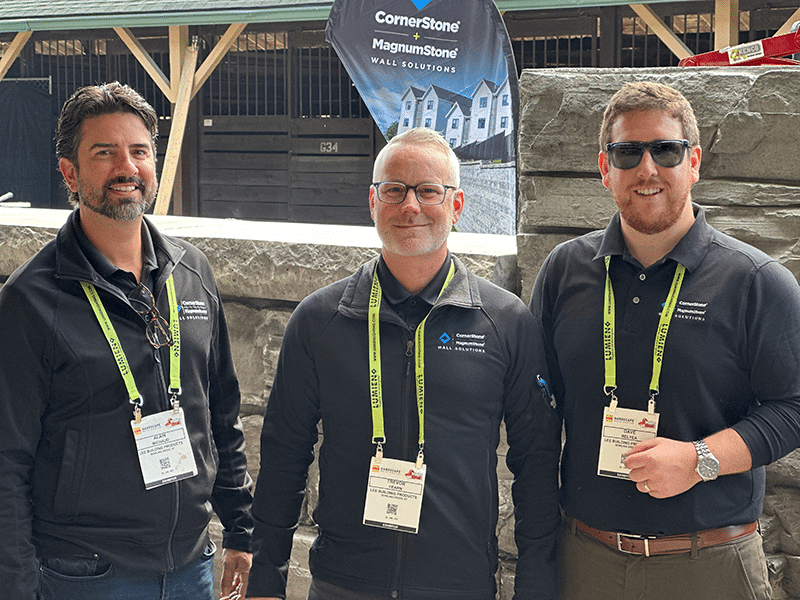
Trevor Fearn (center) is pictured with his colleagues at Hardscape North America.

“By prioritizing responsiveness and reliability, I’ve been able to unlock new opportunities and advance my career. Being at the top of a professional’s referral list is a powerful asset in this industry.”

Organizational Support

Organizations like the Concrete Masonry & Hardscapes Association (CMHA) support both the craftsmanship and relationship-building aspects that are key to a good reputation in the industry. Industry events and trade shows offer invaluable networking opportunities for both new and experienced hardscapers.

Vear strongly recommends attending trade events like Hardscape North America, which is hosted by CMHA. These gatherings provide not just education but crucial networking opportunities with manufacturers and fellow professionals.

“If you can get to HNA, that’s absolute—you have to go to that. If you’re in this industry and you don’t go to HNA, you are missing out on everything,” Vear said.

For Dan Hughes, President and Owner of Segmental Systems Inc., building a national network of hardscapers has been integral to growing his skills and knowledge. He credits CMHA with the connections that have bolstered his business into an industry leader. 

“I used to look at these guys that were involved and they’re writing articles and magazines, and they’re doing stuff. And I know who these guys were. As I got involved in the organization, I’m actually now friends with these guys that used to be my mentors,” Hughes said. “…And I’ve made some great friends. But it’s being involved that really grew me as a professional and really elevated my level of knowledge in the industry. The discussions that I have, both within meetings and outside meetings, with these individuals are some of the best, most intelligent conversations you can have about the industry.”

Dan Hughes, President and Owner of Segmental Systems Inc. (center) is pictured at Hardscape North America.

Unlocking Opportunities Through Networking

Networking is also about maintaining existing relationships. Whether it’s keeping in touch with past clients, staying active in professional circles, or engaging with peers online, relationships built over time can lead to unexpected job opportunities and partnerships.

“Networking is key to growing in this industry. I stay active in professional associations like CMHA, attend trade shows, and participate in training workshops to connect with peers and suppliers. Social media platforms, such as LinkedIn, also help me showcase my work and engage with others in the field. Additionally, maintaining strong relationships with industry professionals has opened doors to new opportunities and collaborations,” Fearn said.

“The key is to provide value—whether that’s sharing insights, offering help, or simply staying in touch consistently.”

For job seekers looking to break into hardscaping, the key to success lies in both relationships and quality work. Your reputation will determine how many doors open for you, and word-of-mouth can be your strongest asset. Be sure to check out our companion blog post, Reputation Matters in Hardscaping: Building a Reputation Through Quality Work, on how delivering high-quality work strengthens your professional reputation.

Lessons from a ‘Once-in-a-Lifetime’ Hardscaping Project: Downtown Ecosystem in Springfield, Illinois

When Landon Kirby, owner of Knob Hill Landscape Company, first visited the site for what would become the Downtown Ecosystem, he knew this was a “once-in-a-lifetime project.”

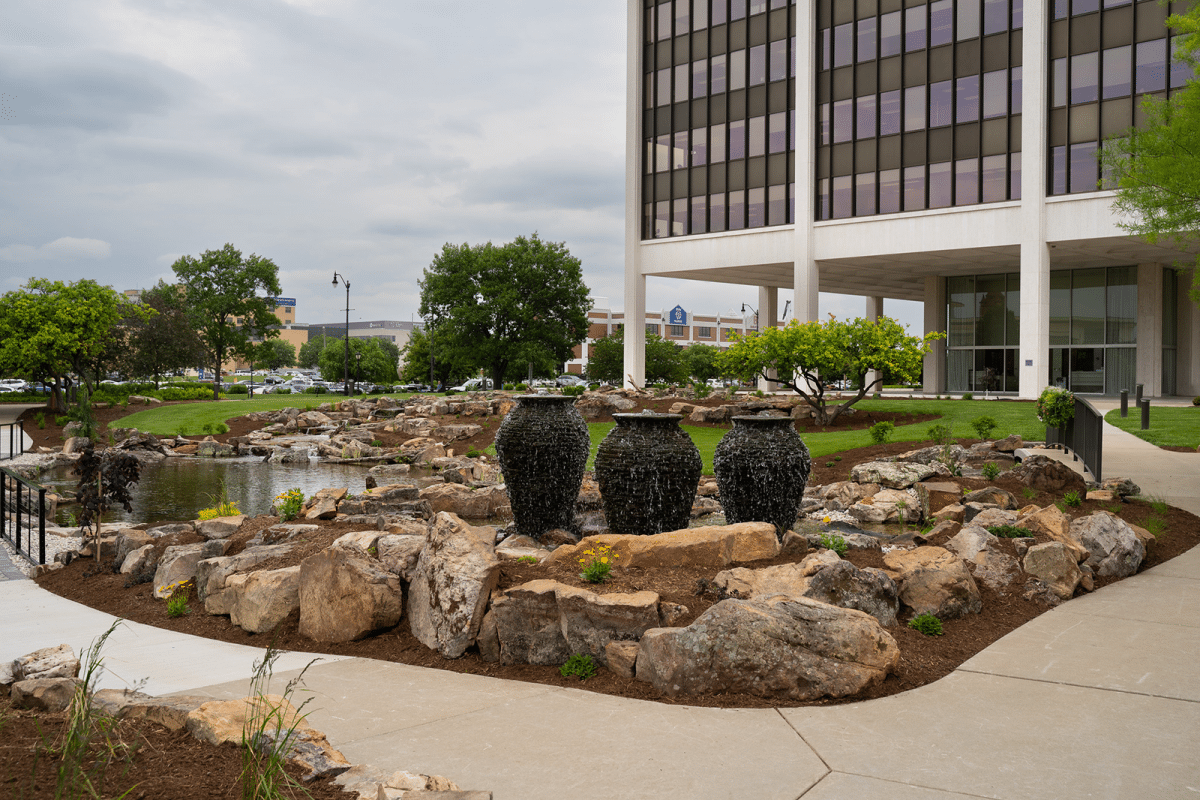
Nestled in the heart of downtown Springfield, Illinois, the Downtown Ecosystem is a living, breathing example of what’s possible with sustainable landscaping and hardscaping. What began as a client’s need to replace a 50-year-old concrete fountain evolved into a full ecosystem designed to recreate nature’s filtration processes and support aquatic life without the use of chemicals.

Kirby said they originally pitched two concepts for the project – one within the existing fountain footprint and the second that captured this larger educational opportunity and unique landscape. The client felt the same passion as Kirby and went for option two.

Mimicking Mother Nature

“My very first time I went there for a site visit I immediately got the thought of this ecosystem and the ponds and the waterfalls because the terrain was kind of rolling. I just got to thinking that this is a great opportunity because ecosystems are very neat, how they work, being all naturally filtered and very unique if you know how the whole system works,” Kirby said.

“You’re mimicking Mother Nature and the natural ecosystem. You’re showing how the water can be cleared without chemicals, how the fish play a part. The aquatic plants play a part, the waterfalls with the oxygenation of the water for the fish, and it just kept hitting me – this is a great opportunity to teach people about this.”

The educational opportunities also fell in line with the client’s mission, as their company works with educators and teachers.

“This is the perfect opportunity and they really thought the same thing. They trusted our vision,” Kirby said.

Sustainable Transformation

Transforming this space into a fully functional ecosystem was no small task.

At the north end of the ecosystem, a wetland filter was carefully constructed to naturally cleanse the water as it flows through multiple layers of river rock. This method mimics marshy areas near rivers and lakes, ensuring water clarity and a thriving habitat. On the opposite end, an intake bay with pumps pre-filters the water before recirculating it through the system.

The design also features three waterfalls, not just for aesthetics but to enhance oxygenation and improve the environment for fish. Additional features like strategically placed woody materials support beneficial microorganisms, and fish play a crucial role in the ecosystem by feeding on algae and producing nutrients for plant life.

The project included 2,000 square feet of permeable pavers. The permeable paver patio joints between the pavers were filled with granite chips, allowing the rainwater to penetrate the pavers. This prevents any storm water runoff from entering the ecosystem and possibly contaminating the water source.

And to top it off, Kirby’s team of eight built this space over 101 days in the heart of an Illinois winter.

“In Illinois, the winters are pretty sketchy. We do get snow. We do freeze. We actually started that project the first week of November and we finished the last week of April. We were really worried at first, but it was the only project we were working on in the winter, so it allowed every employee to be focused on it,” Kirby said.

“…It was a once-in-a-lifetime project and I recognized it. All our employees recognized it. We all treated it like that. We didn’t cut any corners. We just tried to make it the best we absolutely could.”

The effort paid off. The project won a National Association of Landscape Professions “Gold” Award of Excellence in 2023 and at the 2024 Hardscape North America awards, it won the Combination of Hardscape Products – Commercial category.

“We’re from a relatively small market and we are still a relatively small company. To be recognized on that level is very special. It puts things in perspective and takes away a lot of all those stresses and things that you worry about so much,” Kirby said. “Our employees love it. It means the world to me for them to be recognized for their skills.”

Always Evolving

For aspiring hardscapers who want to one day be part of their own award-winning projects, Kirby advises that every project should be a learning opportunity.

“Always know that you can be better than you were yesterday,” Kirby said. “We won a national award, but we also still understand that we could have done something better. There’s a long list of things that we would improve from this project after having done it. Learn from every project and just have that mindset of continuously wanting to get better.”

Kirby’s favorite part of the Downtown Ecosystem project is the way it changes over time. He has been working with the client to lead tours and field trips for students to share and educate about the ecosystem and he said that he discovers something new on every visit.

“That’s one of the things with ecosystems, they’re always evolving because they are living and growing and changing,” Kirby said.

“Every time I go there, I notice something different that’s changed or a new plant that’s popped up and growing out of the boulders all of a sudden. Some of those seeds could have been on those boulders for hundreds of years, and now, all of a sudden, it’s the right conditions and now they’re sprouting grass out of the boulders. It’s amazing.”

The original request was for a fountain repair, but Knob Hill Landscaping saw an opportunity to create something much bigger. The Downtown Ecosystem isn’t just an award-winning project—it’s a new benchmark for what’s possible in urban landscapes.

Hardscaping: The Perfect Career for Lifelong Learners

A Strong Foundation for Success

Lee Krinzman, Director of Education & Certification at the Concrete Masonry & Hardscapes Association (CMHA), said there are comprehensive educational opportunities available to industry newcomers and veterans alike.

“For anyone new to hardscaping, Hardscapingis.com is the perfect place to start. The site outlines training and educational opportunities, industry insights, and career guidance to help build a strong foundation,” Krinzman said. “Hardscaping offers a variety of career paths—including installation, design, sales, and business ownership—and the website outlines these opportunities to help you find the right fit. With these resources, you’ll gain the skills and confidence with the right footing to start a successful hardscaping career!”

Staying the Course

What makes hardscaping particularly appealing to learning enthusiasts is its multi-faceted nature. Each specialization requires its own set of skills and knowledge, allowing professionals to continuously expand their expertise or even transition between different roles as their interests evolve.

“CMHA offers four main installer courses for anyone in the Hardscaping or Masonry Industry.  We have numerous other certificate courses for people new to the industry, sales staff, and those who just want to know best practices in the industry,” Krinzman said. “Over the past 2-3 years, CMHA has updated our installer courses with best practices for the industry and we encourage anyone looking to learn more to take our courses.”

Andrew Vear, a hardscaping industry consultant with decades of experience in installation, said he encourages people to jump at any opportunity to take a CMHA course.

“It’s one of the best ways to just gain knowledge about what you’re doing and why you’re doing something. Why are we putting in 6 inches of base? Why are we putting 8 inches of base? Why we would only need to put in 4 inches? I mean it explains all of these things so it’s not a mystery,” Vear said. “…The CMHA courses are a huge leap forward. It’s so much easier when you take a class that is in your field. It’s not like a math class where you are like, ‘I don’t understand how all this goes together.’ It’s specifically designed for the installation of pavers so you’re taking a real shortcut. You’re not learning a bunch of stuff you don’t need.”

Commitment to Continuous Improvement

Continuing education and staying updated with evolving industry standards are crucial for hardscaping career longevity.

In addition to a formal education and taking courses, connecting with professionals, attending trade shows, and joining trade organizations can help hardscapers stay informed about emerging trends and new technologies.

“Networking with industry experts, joining trade organizations, and staying updated on trends through webinars and trade shows can further enhance knowledge and skills,” Krinzman said. “The more hands-on practice and industry exposure they gain, the more confident and prepared they’ll be for a successful career in hardscaping.”

Online resources, including YouTube tutorials, webinars, and social media communities, can provide further opportunities to learn and grow.

“Stay curious, adaptable, and committed to learning. The more knowledge and experience you gain, the greater your potential for success,” Krinzman advised.

For lifelong learners, hardscaping provides more than just a career – it offers a path of continuous growth and achievement. With a wide array of educational resources, diverse specialization options, and a strong emphasis on practical skill development, the field perfectly suits those who find joy in learning and satisfaction in mastering new challenges.

GET STARTED WITH A CAREER IN HARDSCAPING TODAY!