
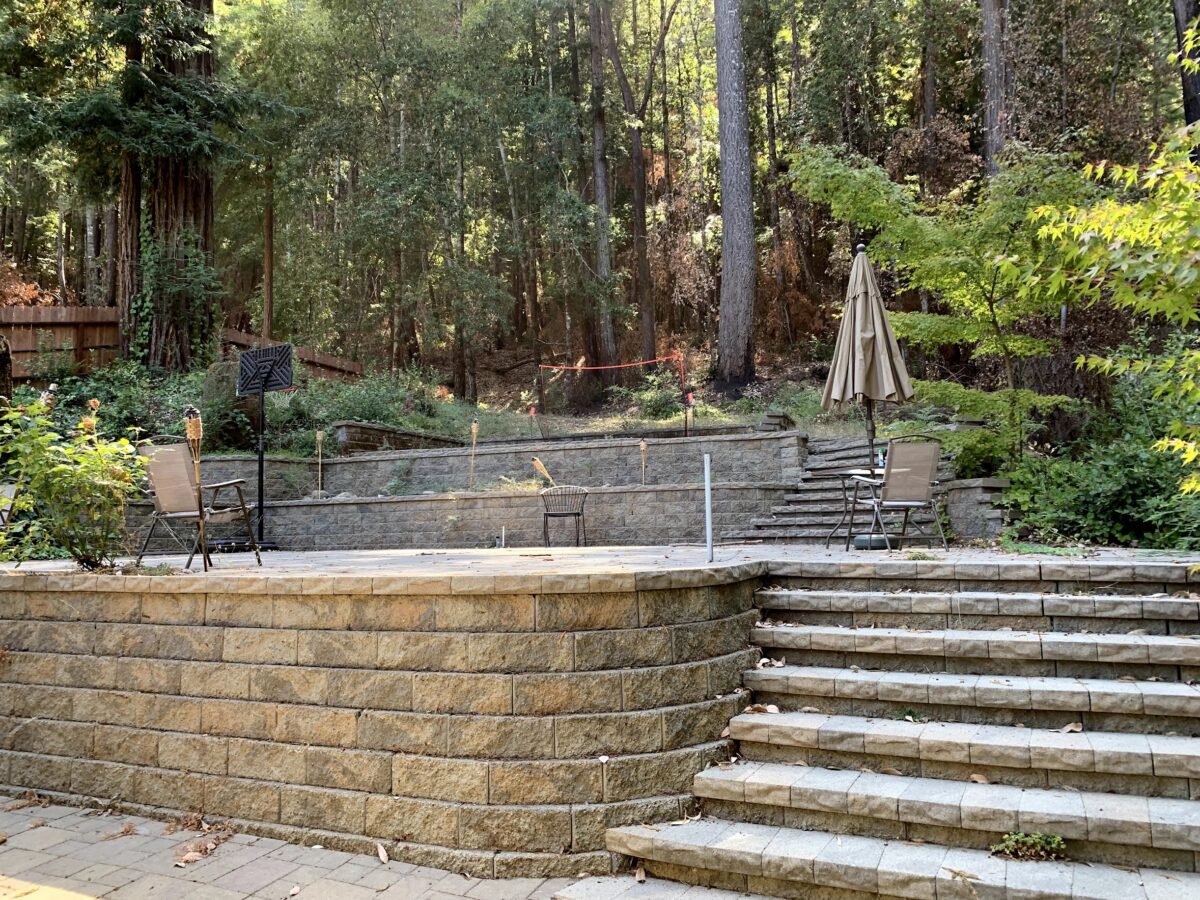
Bryan Dahl didn’t set out to become an expert in firescaping. His career was in medical sales, but he enjoyed building retaining walls and paver patios at his own home.
It was a hobby, not a career plan. Then, a wildfire tore through his small California town and changed everything.
“It burned 1,500 structures,” Dahl said.
The fire moved through the community relentlessly until it reached the first house Dahl and his wife had lived in together. That property was covered in segmental retaining walls and pavers.
The fire stopped because the firefighters had the defensible space they needed. Standing on the hardscapes Dahl had installed crews were able to hold their ground and fight the fire back.
Dahl later learned that if that house had gone up, the entire neighborhood likely would have followed.
That accidental discovery set Dahl on a new path. Today he works in sales for Basalite, bringing his firsthand experience to every conversation about firescaping.
Understanding Landscaping, Hardscaping, Firescaping
For anyone new to the industry, Dahl offers a framework for understanding how landscaping, hardscaping, and firescaping work together to transform a landscape.
Landscaping, he explains, is the art of transforming outdoor space into something vibrant, functional, and visually appealing. Hardscaping is the use of hard landscape materials, such as concrete, stone, pavers, and retaining walls, within that design.
“Firescaping is landscaping and hardscaping with fire protection and prevention in mind,” Dahl said. “They’re not mutually exclusive. It’s a balance of how you prioritize form, function, and fire protection. A good design should be able to blend all three.”
The difference often comes down to small choices in design.
If you’re installing a paver path near a home, you could put it right next to the structure with plants on the other side, or you could put plants close to the foundation and the path further out. For firescaping purposes, you want the pavers nearest the home because that non-combustible surface stops embers from igniting flammable materials.
“You’re not changing a whole lot,” Dahl said. “You’re just changing a little bit of the design with the intent to make your home a little more fire-resistant.”
Building for Resilience
Understanding fires helps clarify why hardscaping is such an effective tool.
Embers, tiny bits of ignited debris, can travel miles ahead of a wildfire and ignite new fires wherever they land on flammable material. And firefighters, who can position themselves to fight a wall of flame, cannot be everywhere an ember might land. By reducing the amount of combustible material around a home, firescaping dramatically improves the odds.
Fires also climb. Ignite grass at the bottom of a hill, and it will burn to the top. Segmental retaining walls built from concrete interrupt that upward creep, creating a fire break between elevation changes.
After the wildfire in Dahl’s town, the first major rainstorm revealed a new problem. With vegetation burned away and soil destabilized, hillsides let loose. Debris flows and flooding followed.
Dahl watched the river near his home turn a deep, dark gray from the runoff. His own retaining wall, not built with that scenario in mind, ended up acting like a dam as water poured over it from across the street.
“I did not build the wall thinking I needed to hold up a waterfall down the road,” he said. “But if you build the wall right, you’ve got a better chance of it standing up in those extreme circumstances.”
Retaining walls providing soil stabilization before, during, and after a disaster event. Using non-combustible concrete and masonry products instead of wood fencing or timber walls also means less damage when disaster strikes, and less material that needs to be replaced afterward.
Designing in Zones
Firescaping gives hardscapers a new way of thinking about designing the space around a home.
“Firescaping principles divide property into distinct, defensible space zones,” Dahl said.
The innermost area, Zone 0, covers the zero to five feet immediately surrounding the structure. This is the highest-stakes zone, and everything here should be non-combustible. Concrete, stone, or paver patios and walkways directly adjacent to the home form a critical barrier against ember ignition.
Moving outward, Zone 1 spans five to 30 feet from the home. Here, hardscaping continues to do heavy lifting. Stone or concrete retaining walls can separate plant groupings and interrupt fire’s path, while a paver driveway creates a substantial non-combustible area. Permeable pavers are a particularly smart choice in this zone, offering fire resistance and the added benefit of channeling water away during heavy rains.
Beyond 30 feet and out to the property line or roughly one hundred feet, Zone 2 calls for a continuation of the same principles. Large boulder features can serve as natural firebreaks, paver or concrete paths break up stretches of vegetation, and retaining walls on sloped properties help prevent erosion while slowing water flow.
Advice for Aspiring and Early Career Hardscapers
When a hardscaper can walk a client through that framework and explain what materials belong where and why, they’re offering something truly valuable.
“If you build out the landscape design in a way that both protects and looks beautiful, you’re going to be somebody who is thinking big picture,” Dahl said.
Wayne Villaluna, Basalite’s Engineered Products Division Manager, agreed. At minimum, learn the basics of firescaping and the relevant local regulations — the zones, the mandates, the materials that qualify as non-combustible.
“If you want to be the exception and not the commodity,” Villaluna said, “be the person in the room who knows this stuff.”
Dahl noted that firescaping is now mandated in California and California frequently sets the regulatory precedent that other states eventually follow. Understanding firescaping now positions aspiring and early career hardscapers to be ahead of that curve, not scrambling to catch up when the rules change in their own state.
Dahl and Villaluna also encourage early career hardscapers to master the fundamentals. Walls fail for reasons that have nothing to do with fire — poor installation, inadequate drainage, insufficient engineering — and in the extreme circumstances that follow a wildfire or major storm, those failures become very visible very fast.
Building correctly from the start is what creates structures that hold up when they’re tested.
Seeing the Solution
“As a hardscaper,” Villaluna said, “firescaping is a solution we can provide for a condition that’s out there.”
Concrete block, segmental retaining walls, permeable pavers, stone features already meet a real and growing need.
Hardscaping can’t do everything to protect a structure. If a home has asphalt shingles and embers land on the roof, even the most beautifully designed paver patio won’t save it. Fire resilience is a whole-system challenge, and hardscapers are a crucial part of that system.
“It takes all of us within construction,” Villaluna said. “Roofs, windows, doors, walls, garage doors — everything. We’ll take care of the hardscaping. We’ll create masonry walls that are wonderful fire breaks, retaining walls that create these steps, pavers that create a non-combustible area.”
For the next generation of hardscapers, that’s an opening. The skills, the products, and the knowledge to help homeowners protect what matters most already exist. Learning to deploy them thoughtfully and to help clients understand why it matters is one of the most valuable things a new professional in this industry can do.