
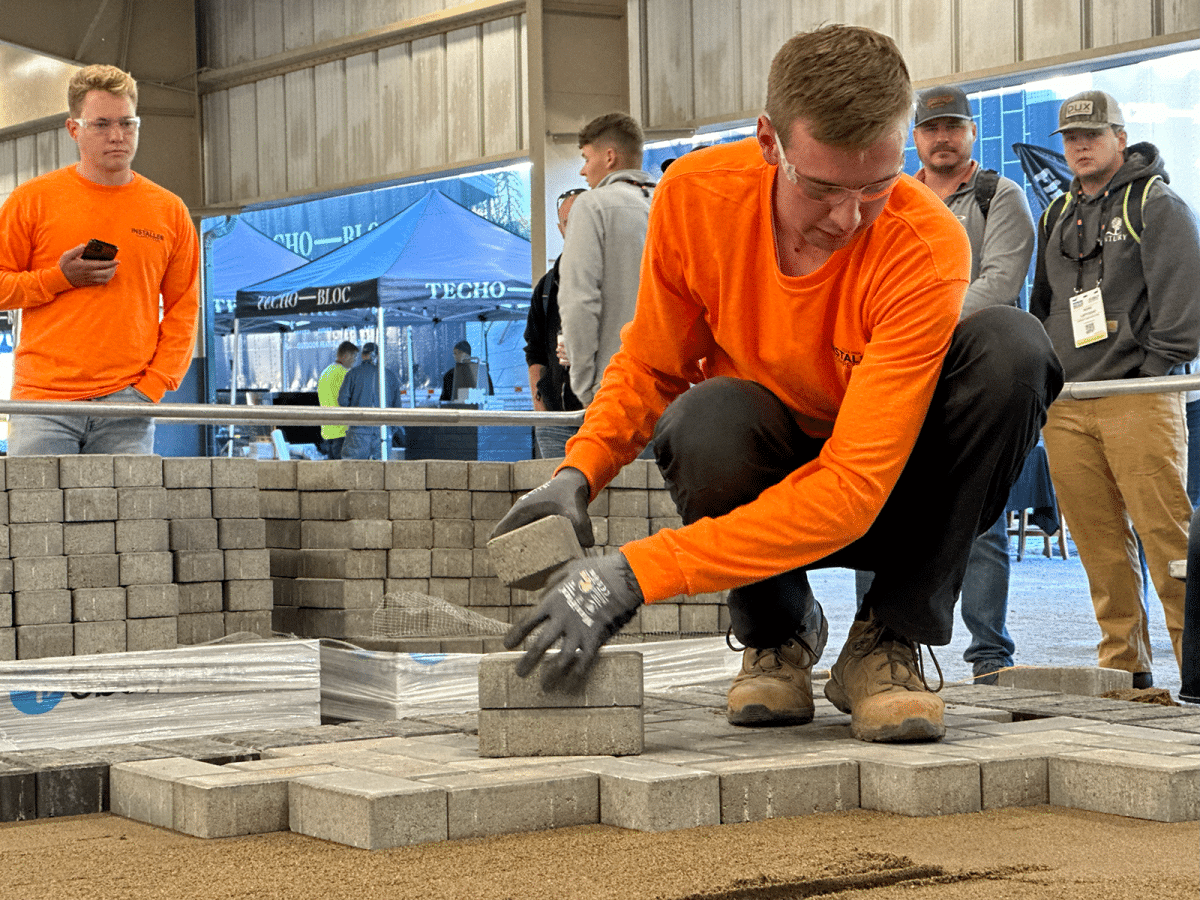
Brigham Young University’s landscaping program works to shape the next generation of outdoor design professionals. These students have the opportunity to not just learn in the classroom, but to also gain experience on a national stage.
Greg V. Jolley, PLA, ASLA, Professor of Plant and Landscape Systems, often brings a team of students to the annual National Competition at Hardscape North America, where they test their skills against some of the best in the country.
But for Jolley, the competition isn’t just about trophies. It’s about giving students real-world confidence, hands-on experience, and the chance to see themselves as future leaders in the industry.
From Theory to Practice
Jolley’s own path to teaching started after five years of professional practice at a landscape architecture firm in Jackson, Wyoming. When an opening came up at his alma mater in 2003, he jumped at the chance to return. For him, this was a return not just to BYU, but to the same campus where his father had been a professor.
“To be able to go back and have the opportunity to teach in the same place he did, and to be able to teach the topic I loved, it was a no-brainer,” Jolley said.
That real-world experience has proven invaluable in the classroom. Four-year universities excel at teaching theory, Jolley noted, but hands-on skills can be harder to incorporate into the curriculum.
That’s where competitions like Hardscape North America come in.
Hands-On Learning, Real-World Results
BYU has been involved in landscape competitions since the late 1990s, and Jolley has been part of that effort since he arrived back on campus. To bridge the gap between classroom learning and practical skills, he formalized a partnership with BYU’s grounds department in 2003, requiring all students to work there for at least one semester.
“Most students would end up working for more than just one semester,” Jolley said. “They may end up working for two years, three years. If they get into that program early enough, sometimes even gain four years of experience.”
Competitions build on that hands-on foundation by offering a deep dive into specific skills.
“In the case of hardscape installation, just in the preparation leading up to a competition, they can gain hours upon hours of experience,” Jolley said. “It gives them a little bit more depth in the subject than we could otherwise provide as professors or in an academic setting.”
When Jolley asks students about their competition experience, one word comes up repeatedly: invaluable.
“Just to be able to observe professionals doing the work and being able to talk with them and get feedback from them. You have such skilled laborers installing these hardscapes, and just being able to watch them for a couple of rounds of the competition is invaluable,” he said. “I think it generates more ideas in their mind of ways that they can go about their work.”
More Than Just Hard Skills
Jolley also emphasizes that competitions teach soft skills, critical skills that every professional needs.
“We oftentimes think of the install as being just hard skills and that’s it,” he said. “But the soft skills of communication—how do you communicate with one another? How do you problem solve? You might be in the middle of the competition and you have to pivot or adjust what your original strategy was.”
Jolley also encourages his students to stay connected with professional associations, to educate others, and to support their fellow practitioners.
“We want our students to have as they go out into the world a desire to continue to learn and continue to serve in whatever communities that they’re in,” he said.
It’s a philosophy reflected in BYU’s motto: “Enter to learn, go forth to serve.”
“We try and emphasize that to our students that go out into the industry,” Jolley said. And it’s a principle he embodied in his own career trajectory from student to practitioner to educator.
Whether students end up installing patios, designing outdoor spaces, or another industry entirely, the skills and connections they gain at competitions like Hardscape North America become part of a foundation that lasts a lifetime.